
Watch: Liquid-filled window saves energy
S. Himmelstein | November 09, 2020Windows are the least energy-efficient component in a building’s design and exert major impact on the heating and cooling costs of a building. Conventional energy-saving low-emissivity windows made with expensive coatings reduce the admission of infrared light to help reduce demand for heating and cooling needs, but they do not regulate visible light and its associated heating impacts such as sunlight that causes buildings to heat up. A high thermal energy storage thermoresponsive smart window was designed at Nanyang Technological University, Singapore, to address this limitation in fenestration performance.
A proprietary hydrogel, water and a stabilizing compound are sandwiched between two panes of glass in a structure that can effectively reduce energy consumption in a variety of climates, due to its ability to respond to a change in temperature. The liquid mixture turns opaque when exposed to heat, thus blocking sunlight, and 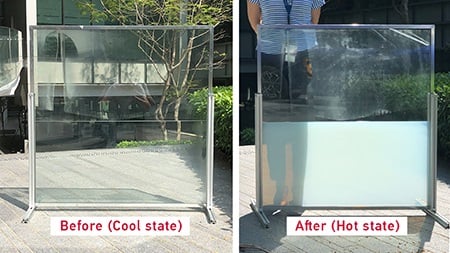 A composite photo shows the window in the before (cool) and after (hot) state. Source: Nanyang Technological Universityreturns to its original clear state as it cools. The high heat capacity of water allows a large amount of thermal energy to be stored instead of transferred through the glass and into the building during hot daytime conditions. The stored thermal energy is released at night into the building’s interior, reducing demands on the heating system.
Outdoor proof of concept tests conducted in the hot climate of Singapore demonstrated that the new window system had a lower temperature of 50° C during the hottest time of the day compared to the 84° C recorded for a conventional glass window. Similar trials performed in the colder environment of Beijing, China, showed that a room equipped with the smart liquid window consumed 11% less energy to maintain the same temperature compared to a room with a normal glass window.
Soundproof tests also suggested that the smart liquid window reduces noise 15% more effectively than double-glazed windows.
The research is published in Joule.


Interesting.
Or you can pull the shades.
I wonder how it would handle the cold winters in higher latitudes. No fear of freezing in Singapore is there!
I would rather have a solar (or some transducer) shade, that would also light up the room, as I darken it - by opaque-ing/ closing the shade.
I assume the temperature quoted was the outside pane, what was the temperature of the inside pane as this will determine the heat load on the room.
Air is a much poorer conductor of heat than water so this concept does not make much sense unless something special is happening.