"PowerWindows" Convert Light into Electricity
By Engineering360 News Desk | April 12, 2016Rabobank's new headquarters building in Eindhoven, The Netherlands, will be outfitted with windows that convert light into electricity.
Physee, a spin-off company of the Delft University of Technology, will install 30 square meters of PowerWindows, its first such installation, as part of a pilot program to validate the technology beginning in June 2016.
While conventional glass reflects about 30% of the incoming light, PowerWindows instead collect this light with a coating on the outside windowpane, transport it through the glass to the edges of the window and convert it at solar cell strips inside the window frame. Combined with a thermal storage system, Physee says PowerWindows can save up to 50% of the total energy demand (electricity and heating) when renovating conventional commercial buildings and up to 100% in newly constructed commercial buildings, with a payback time of three to five
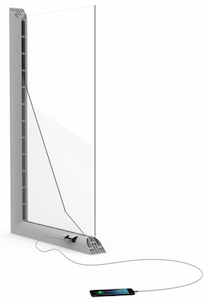 The window collects light via a coating on the pane, converting it at solar cells in the frame. Image credit: Physee.PowerWindows' coating consists of an industry standard host crystal doped with a 3% concentration of luminescent material. In contrast to previous luminescent solar concentrators (LSCs), the material Physee uses absorbs uniformly over the entire spectrum of ultraviolet and visible light and emits in the near-infrared, so there is no overlap between the absorption and emission spectrum. As a result, the coating is colorless and has no self-absorption, resulting in a scalable and power-efficient LSC.
The efficiency of PowerWindows scales with their transparency. Physee says PowerWindows with the same transparency as conventional glass can produce 20W/m2 while dark-tinted PowerWindows can produce 45W/m2.
An advantage of PowerWindows for electricity generation is that they are not restricted to a small space, as is frequently the case with rooftop solar panels. Physee says this makes it possible to significantly reduce the energy footprint of buildings without compromising the user experience, unlike smart-energy-window solutions that have low efficiencies. According to Physee, PowerWindows also increase the energy efficiency of buildings and save on air-conditioning costs by preventing the building from heating up inside.
PowerWindows can be used with any type of transparent surface—straight, curved, plastic, single pane, double pane, etc. According to Physee, the windows generate electricity in either direct or indirect light and at any angle to the sun, as the collection of light occurs independently of window orientation.