US Army technology can detect subtle, real time changes in an environment
Marie Donlon | August 24, 2020Scientists with the United States Army have developed technology that enables robots to inform their soldier counterparts about imperceptible changes in their surroundings, which could potentially signal a danger in that environment.
The team of scientists outfitted an autonomous mobile ground robot with lidar (laser ranging sensors) to construct a representation of the setting while a human soldier wears augmented reality (AR) glasses. As the robot patrols the live environment, it compares the new data with the data depicted in the representation. Any changes detected between the two are immediately relayed to the soldier via the AR headset display.
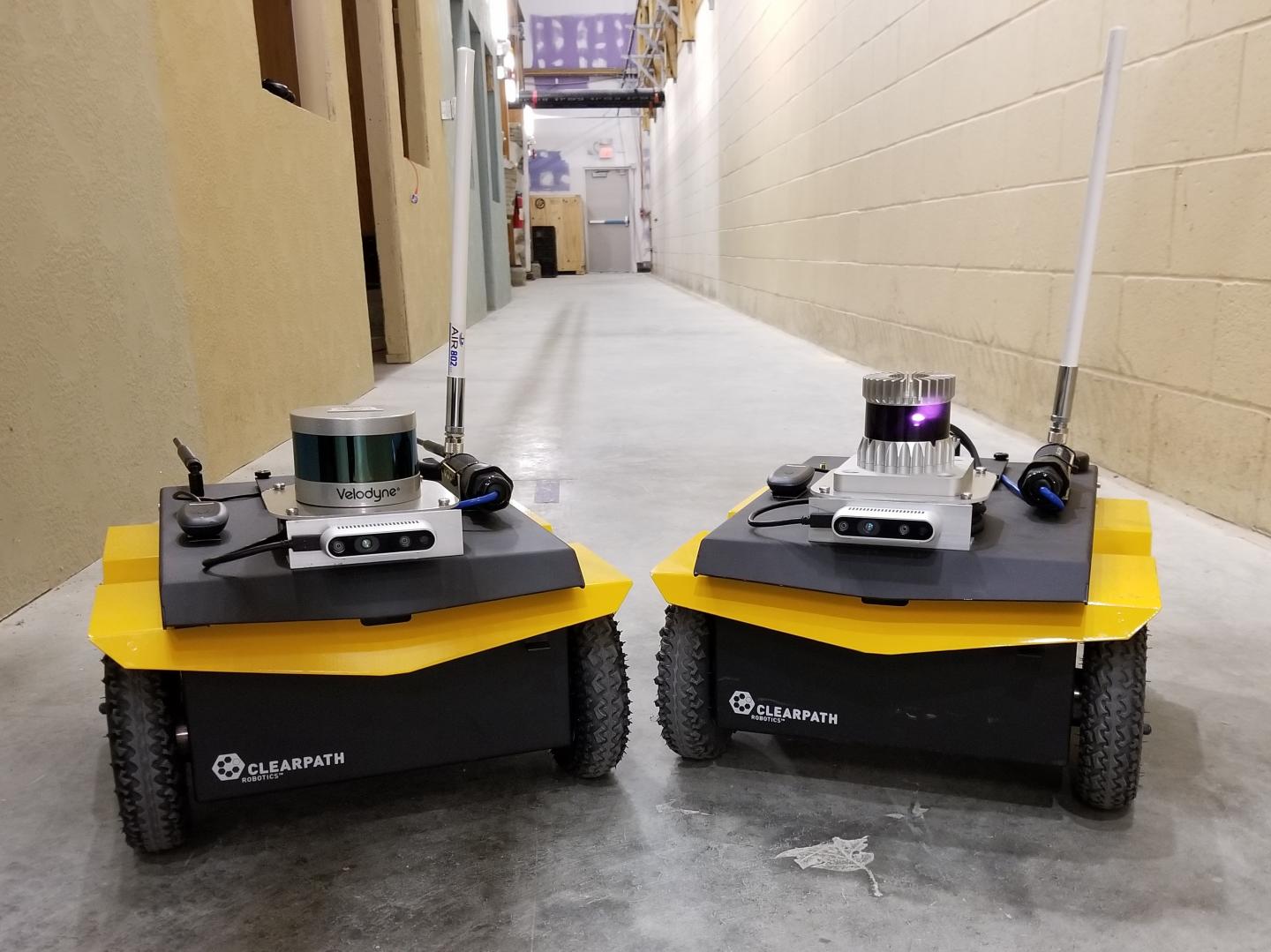 The two robots used in the experiments are identically equipped, with the exception of Velodyne VLP-16 lidar (left) and Ouster OS1 lidar (right). Source: U.S. Army
According to its developers, the system could potentially be incorporated into technologies such as the Army's Integrated Visual Augmentation System (IVAS) goggles, thereby improving a soldier’s situational awareness.
The team intends to eventually enable the technology to distinguish between changes that potentially signal a danger to soldiers — a camouflaged enemy, for instance — and changes that are innocuous.
The research, Enabling Situational Awareness via Augmented Reality of Autonomous Robot-Based Environmental Change Detection, was presented at the 12th International Conference on Virtual, Augmented, and Mixed Reality, which is part of the International Conference on Human-Computer Interaction.