
Reusable nanowire-equipped mask kills pathogens
S. Himmelstein | August 11, 2020Most people seem to be sporting paper masks as part of the global effort to stem the COVID-19 pandemic. Such gear is effective in protecting the user from contracting the virus, but only trap instead of destroying pathogens. Disposal of masks manufactured with non-woven polypropylene plastic microfibers also poses an environmental burden. A possible solution in the form of a reusable mask equipped with a titanium dioxide nanowire filter that photocatalytically deactivates pathogens has been engineered at Ecole Polytechnique Fédérale de Lausanne, Switzerland.
When exposed to ultraviolet radiation, the filter fibers convert resident moisture into oxidizing agents such as hydrogen peroxide, which destroy pathogens. The titanium dioxide nanowire-based material has a high 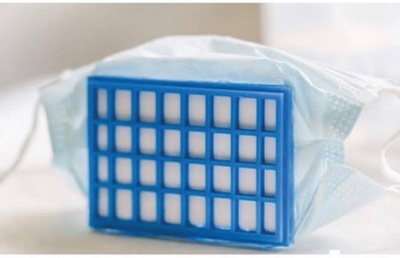 A mask prototype in which the titanium dioxide nanowire filter paper is attached to a 3D-printed plastic frame. Source: Endre Horváth et aldielectric constant and is super-hydrophilic, enabling capture of pathogen-laden water droplets and enhancing filtration efficiency, and pore sizes can be tuned to trap microorganisms of different sizes.
The nanowire filters were demonstrated to destroy Escherichia coli and DNA strands in a matter of seconds and is expected to prove as effective in deactivating the coronavirus. The light‐sterilizable mask may be reused more than 1,000 times, potentially resolving personal protective equipment shortage and waste disposal problems. The facility’s laboratory can currently produce up to 200 m2 of filter paper per week, or enough for up to 80,000 masks per month.
A paper on this research is published in Advanced Functional Materials.
Let the field trials begin!