Polymeric heart valve proves durable and biocompatible
S. Himmelstein | July 01, 2020More than 1 million heart valve replacement procedures are performed annually worldwide by use of biological or mechanical valves. The former are highly biocompatible but have a service life of only 10 to 15 years, while the latter are highly durable with poor biocompatibility characteristics. An artificial valve that combines the merits of these available devices without the limitations has been designed by an international research team.
The new heart valve features a life span potentially longer than that of biological replacements and spares recipients the burden of taking blood thinner medicines as would be required with mechanical valve implantation. The co-polymer-based device, designed to resemble the flexibility, biocompatibility and durability 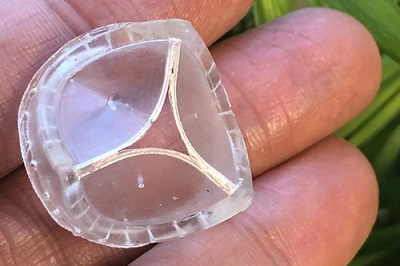 A prototype polymeric heart valve. Source: Raimondo Ascione et al.of a natural heart valve, is fabricated with a simple molding process that promises reductions in manufacturing and quality control costs.
ISO standards require a new artificial heart valve to withstand a minimum of 200 million repetitions of opening and closing during bench testing to be tested in humans. The polymeric valve has surpassed this operating cycle, equivalent to a five-year span, and has also exceeded ISO standards for hydrodynamic testing. A functional performance in vitro comparable to the best-in-class biological valve currently available on the market was demonstrated.
A small feasibility pilot study in-vivo in three sheep at one to 24 hours after surgery confirmed the valve is easy to implant and showed no evidence of mechanical failure or trans-valvular regurgitation.
Researchers from the University of Cambridge (U.K.), Newcastle University (U.K.), the University of Bristol (U.K.) and Politecnico di Milano (Italy) contributed to this development, which is reported in Biomaterials Science.