Blood self-collection device evaluates radiation exposure
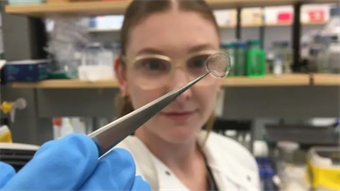
S. Himmelstein | October 30, 2019To help medical personnel and the general public effectively prepare for and respond to nuclear accidents or attacks, modern emergency medical kits are being transformed into more than an assemblage of bandages and disinfectants. A self-administered blood self-collection device has been engineered by Columbia University and  The blood self-collection device. Source: Tabbitha Mosier/University of ArizonaUniversity of Arizona researchers to quickly estimate a person’s exposure to radiation after such an event.
The integrated fingerstick blood collector was designed to aid triage personnel in collecting and processing samples for screening biodosimetry data and applying appropriate radiation countermeasures. A 3D-printed capillary-needle assembly is combined with a pre-vacuumed storage tube containing the required liquid reagent in a device that can process a blood specimen for both cytogenetic and gene expression biodosimetry.
The device was successfully tested for self-collection, and the collected blood was also successfully demonstrated for gene expression and cytogenetic biodosimetry assays. Results are comparable to those delivered using traditional methods and are returned in one day in the gene expression tests and three days with the cytogenic tests. The self-administered device described in PLOS One could also be used for other applications where blood may need to be self-collected by individuals, such as at home.