This developer plans to build 800 MW of renewables plus storage
Engineering360 News Desk | July 31, 2019NextEra Energy Resources reportedly has agreed with Oklahoma-based Western Farmers Electric Cooperative to build one of the largest solar-plus-wind-plus-storage plants in the U.S.
The Skeleton Creek facility, slated for completion by the end of 2023, would include 250 megawatts (MW) of wind capacity, 250 MW of solar power and 200 MW/800 megawatt-hours (MWh) of battery storage.
Published reports said the project would be larger than a project NextEra finalized with Portland General Electric in February, which is slated to be online by the end of 2021. That deal included 300 MW of wind, 50 MW of solar and 30 MW/120 MWh of energy storage.
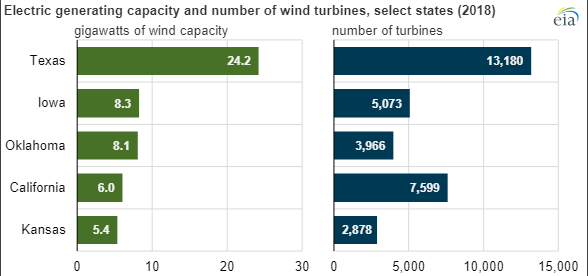 Source: EIAAccording to the Energy Department's Energy Information Administration (EIA), 41 states had at least one installed wind turbine as of January 1. EIA said that as wind technology has advanced, turbines have grown larger and the capacity of individual turbines has increased with size.
Texas continues to have the largest number of wind turbines in the U.S., with more than 13,000 as of the start of 2019. The state also has the most installed wind capacity, at 24.2 gigawatts (GW).
 Wind turbine hub heights have increased over time because turbine blades have gotten longer.States where wind adoption occurred early, such as California, have a high number of turbines relative to their wind generation capacity. The earliest wind turbines still operating in the U.S. were installed in California in July 1975. Despite having the second largest number of installed wind turbines, California accounts for 6.1 GW of total installed capacity, fourth among the states.
EIA said that in 2018 California reduced its number of turbines but increased its wind generating capacity by repowering some turbines to improve their efficiency.
Tennessee has, on average, the oldest operating wind turbines, with an average project age of 17 years. California, Wyoming, Minnesota and Arkansas round out the top five states in terms of oldest project ages, from an average 16 years in California to an average 12 years in Arkansas.
Wind turbine hub heights have increased over time because turbine blades have gotten longer. Turbines with longer blades and a greater rotor diameter typically have higher nameplate capacity. Older turbines, such as those in California or Tennessee, generally are shorter and have shorter blades than newer turbines.