Portable platform designed to personalize chemotherapy
S. Himmelstein | July 22, 2019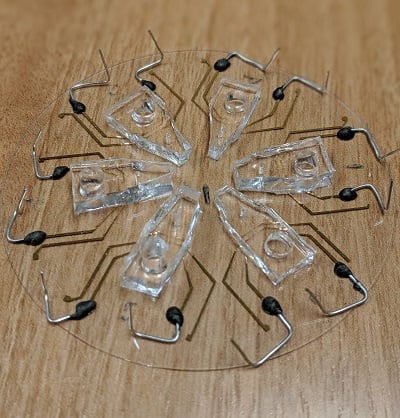 Six devices, each on a 3 in wide piece of glass, with biosensors designed to detect whether a cancer cell is alive when it passes through a microfluidic channel. Source: Zhongtian Lin, Rutgers University
Chemical agents are commonly used to destroy cancer cells, but chemotherapy also destroys healthy cells, can incur an array of side effects and may not prove effective for every patient. Researchers are developing more personalized, precision-based approaches to better target tumors with appropriate chemo drugs. Rutgers University researchers engineered a portable system that combines biosensors with artificial intelligence technology to quickly determine whether a given chemo agent works on a patient’s specific tumor.
The microfluidic impedance cytometry platform returns immediate results and will allow for more personalized interventions for patients as well as better management and detection of the disease. It can rapidly analyze cells without having to stain them, allowing for further molecular analysis and instantaneous results.
Cancer cells treated with antibody-conjugated drugs pass between micro-fabricated electrodes through a tiny fluidic channel. A multifrequency impedance cytometry sensor determines the percentage of live and dead tumor cells in the sample, and the data is analyzed by machine learning models. A larger proportion of dead cells in the samples indicates that the targeted therapy will be effective.
The device was demonstrated to be up to 95.9% accurate when tested using cancer cells that had been treated with varying doses of an anti-cancer drug. A paper on the potential point-of-care diagnostic tool is published in Microsystems & Nanoengineering.