Rib-attached bioreactor grows bone for jaw repair
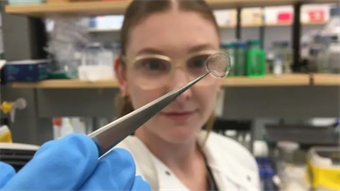
S. Himmelstein | March 20, 2019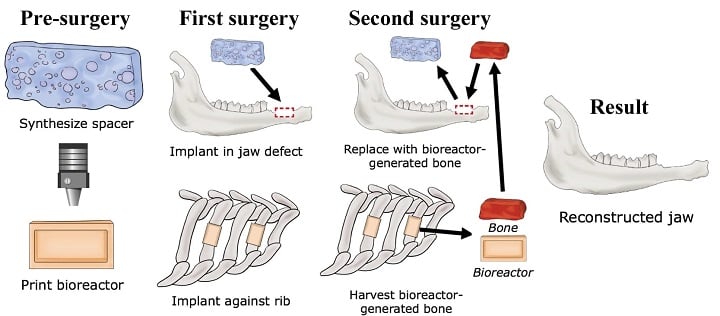 The technique grows custom-fit bone implants to repair jawbone injuries from a patient’s own rib. Source: Mikos Research Group/Rice University
The repair of mandibular defects has posed challenges due to the complexities associated with jaw anatomy and harvesting bone tissue from the patient. A new in vivo bioreactor strategy uses biomaterials and 3D printing to leverage the body’s own innate healing capacity to generate customized engineered tissues that fit a patient’s defect.
The craniofacial reconstruction technique attaches a 3D-printed bioreactor to the patient’s rib to grow bone grafts from artificial bone substitute materials. The implants are filled with biomaterial scaffold materials and serve as molds to nourish development of customized bony tissues for use in other parts of the body.
The process was demonstrated in the reconstruction of mandibular defects in sheep. Using a template for 3D printing, an implantable mold and a spacer – intended to prevent scar tissue formation and promote healing – were synthesized of poly (methyl methacrylate) thermoplastic. The bioreactor devices were implanted against rib periosteum, and after nine weeks the new autologous bony tissue was successfully used to repair the jaw defects.
Initially developed by researchers from Rice University, University of Texas Health Science Center at Houston, Synthasome Inc (California) and Radboud University (The Netherlands) to address battlefield injuries, the bioreactor system should also prove applicable for civilian use.