Watch the Bioengineering of Personalized Bone Grafts
S. Himmelstein | July 19, 2018Researchers at the New York Stem Cell Foundation have developed a technique to produce bioengineered bone grafts for large bone defects, which are currently difficult to treat using conventional techniques. The technology combines segments of bone engineered from stem cells to create large-scale, personalized grafts that will enhance treatment for those suffering from bone disease or injury through regenerative medicine.
Clinicians currently use either synthetic materials or bone grafts from the patient or a donor. These grafts can 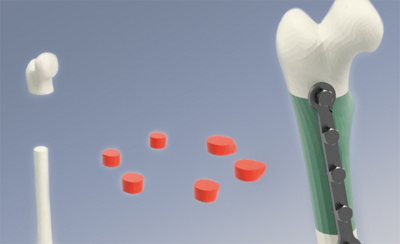 Source: New York Stem Cell Foundation trigger an immune response, and do not always integrate with the surrounding bone. One solution is to use biomaterials seeded with patient-specific stem cells to create bioengineered bone grafts, but it is difficult to create bioengineered grafts for large bone defects, as getting cells to grow throughout a large scaffold is problematic.
Segmental additive tissue engineering (SATE) involves mapping the bone defect using CT imaging, and then producing a customized biomaterial scaffold using computer manufacturing techniques. By producing the scaffold in small segments, the researchers can then grow patient-specific stem cells on the segments in a bioreactor, which ensures that the cells grow uniformly throughout each scaffold segment. Once the segments are ready, the researchers assemble them in the large bone defect using a biocompatible bone adhesive to create an intact bioengineered bone graft.
The SATE technique was tested in a rabbit femur defect that accounted for 30 percent of the bone volume and demonstrated production of a mechanically stable bone graft. They hope that the approach will eventually help patients suffering from large bone defects.
The research is published in Scientific Reports.