Microscopic Shape-Changing Materials Mimic Nature
S. Himmelstein | December 06, 2018Adaptive functions triggered by external stimuli, such as an organism’s ability to change color, are common in nature but difficult to replicate in the laboratory. Efforts to develop stimuli-responsive microstructures based on liquid-crystalline elastomers (LCEs), rubbery networks with attached liquid crystalline groups that dictate the directions in which the material can move and stretch, have not been entirely successful. Synthetic LCEs deform in only one or two dimensions, limiting the structures' ability to move throughout space and take on different shapes.
Harvard University researchers have used magnetic fields to control LCE molecular structures and create microscopic 3D polymer shapes that can be programmed to move in any direction in response to various 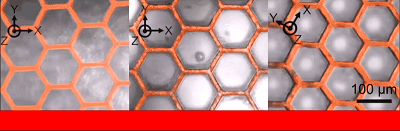 LCEs deform in response to heat, and the shape they take depends on the alignment of their internal crystalline elements. Source: Wyss Institute at Harvard University stimuli. The advancement could lend itself to soft robotics applications or the design of solar panels that turn to follow the sun.
The microstructures composed of LCEs are formed into arbitrary shapes that can deform in response to heat, light and humidity. Exposing the LCE precursors to a magnetic field during synthesis causes liquid crystalline elements inside the LCEs to align along the magnetic field. This molecular alignment is retained after the polymer solidifies. Varying the direction of the magnetic field during this process governs how the resulting LCE shapes deform when heated to a temperature that disrupted the orientation of the liquid crystalline structures. When returned to ambient temperature, the deformed structures resumed their initial, internally oriented shape.
The LCE shapes can be programmed to reconfigure themselves in response to light by incorporating light-sensitive cross-linking molecules into the structure during polymerization. When the structure is illuminated from a certain direction, the side facing the light contracts, causing the entire shape to bend toward the light. This type of self-regulated motion allows LCEs to deform in response to their environment and continuously reorient themselves to autonomously follow the light.
The multiresponsive LCEs might be used to engineer solar panels covered with microstructures that turn to track the sun as it moves across the sky for more efficient light capture. The technology could also form the basis of autonomous source-following radios, multilevel encryption, sensors and smart buildings.
The research is published in the journal PNAS.