Printing Shapeshifting Hydrogels in 4D
Engineering360 News Desk | February 02, 2016Scientists at the Wyss Institute for Biologically Inspired Engineering at Harvard University and the Harvard John A. Paulson School of Engineering and Applied Sciences have brought a fourth dimension to their microscale 3D printing technology.
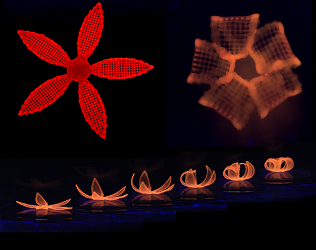 This series of images shows the transformation of a 4D-printed hydrogel composite structure after its submersion in water. Image source: Wyss Institute Inspired by plants, which respond and change their form over time according to environmental stimuli, the team's 4D-printed hydrogel composite structures change shape when immersed in water (see video). "We have now gone beyond integrating form and function to create transformable architectures," says Jennifer Lewis, Sc.D., senior author on the new study.
In nature, flowers and plants have tissue compositions and microstructures that result in dynamic morphologies that change according to their environments. Mimicking the variety of shape changes undergone by plant organs such as tendrils, leaves and flowers in response to environmental stimuli like humidity and/or temperature, the 4D-printed hydrogel composites are programmed to contain precise, localized swelling behaviors.
Importantly, the hydrogel composites contain cellulose fibrils that are derived from wood and are similar to the microstructures that enable shape changes in plants. By aligning cellulose fibrils during printing, the hydrogel composite ink is encoded with anisotropic swelling and stiffness, which can be patterned to produce intricate shape changes. The anisotropic nature of the cellulose fibrils gives rise to varied directional properties that can be predicted and controlled.
When immersed in water, the hydrogel-cellulose fibril ink undergoes differential swelling behavior along and orthogonal to the printing path.
Combined with a proprietary mathematical model that predicts how a 4D object must be printed to achieve prescribed transformable shapes, the new method opens up many potential applications for 4D printing technology including smart textiles, soft electronics, biomedical devices, and tissue engineering.