Hip Replacement Approach Goes to Great Lengths
S. Himmelstein | December 04, 2018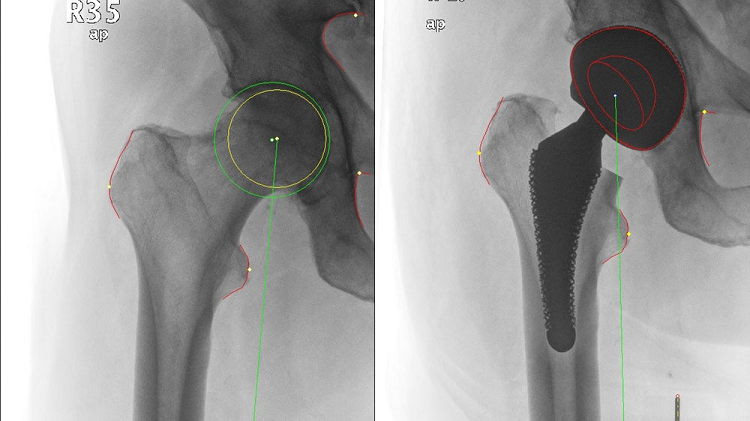 Custom software advises the surgeon on what size implant to select and helps define its position. Source: Fraunhofer IWU
Hip replacement is now commonly viewed as a routine surgical procedure, albeit one with a frequent complication: the leg on the implant side can end up shorter or longer than it was before. Posture problems, back pain and the need for corrective orthopedic assists can result.
A three-tiered solution from Fraunhofer Institute for Machine Tools and Forming Technology IWU and research partners is designed to even up the results of this surgical procedure.
The Optical System
The patient’s tibia is first fitted with a plastic box equipped with optical markers that track motion as the surgeon lifts the heel and rotates the leg. The measurements recorded by a 3D camera are repeated after the implant is initially inserted, and the data is processed by software to compare the two rotational datasets to ensure that the original length is maintained. Any length discrepancy observed is resolved by adjusting the sliding screw connecting the artificial hip's femoral stem and acetabular cup.
Pre-Op Planning Software
This tool advises the surgeon on what size implant to select in the first place, based on patient X-rays and the rotational measurements obtained with the optical system.
Implant Design
A modular design approach enables optimization of device size and position for each patient. Adjustment of a sliding screw connecting the artificial hip's femoral stem and acetabular cup permits correction of any length discrepancy documented by the optical system.
While still in the test phase, the hip replacement system should be ready for clinical use in about two years.