
Dueling Engine Designs Compete in Contest to Power Combat Helicopters
Eric Olson | November 02, 2018Two rival companies are promoting competing engine architectures in a contest to replace the aging T700 turboshaft engines that power the U.S. Army’s AH-64 Longbow Apache and H-60 Series Black Hawk helicopters.
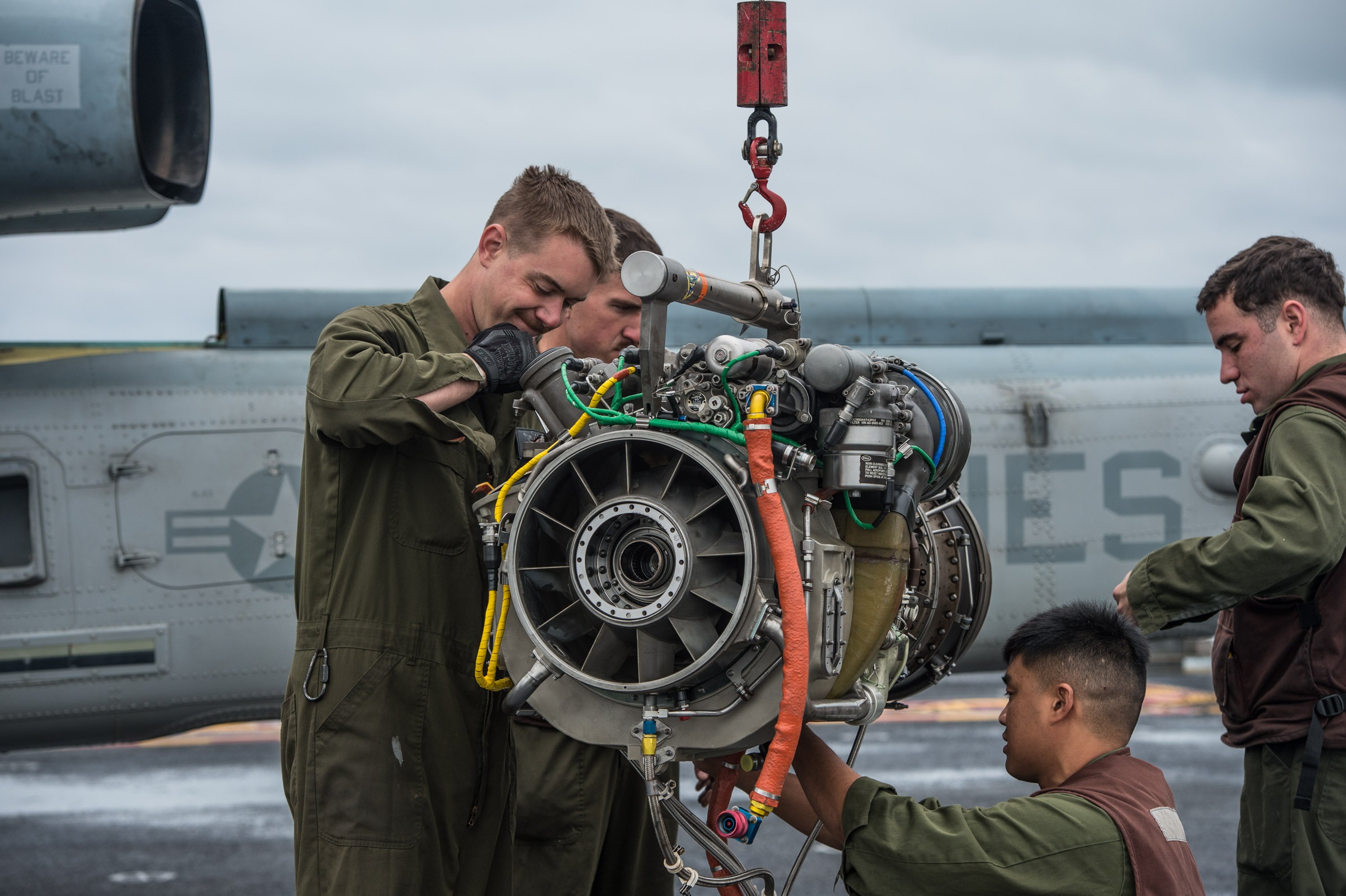 Marines perform maintenance on a T700-GE-401C engine from a Bell UH-1Y Huey helicopter. Variants of the same engine power the Army’s Apache and Black Hawk helicopters. Source: U.S. Navy
GE Aviation and Advanced Turbine Engine Company (ATEC) are participating in the Army’s Improved Turbine Engine Competition (ITEP) to develop an engine that will replace the T700 and also serve as the powerplant for the vehicles that will succeed the Apache and Black Hawk under the Department of Defense’s Future Vertical Lift program.
Single-Spool vs. Dual-Spool
The two organizations are pursuing diverging engine designs in a competition that requires a drop-in replacement for current engines, with matching external dimensions and mounting points. GE Aviation is sticking with a single-spool engine architecture similar to the old T700, which GE has manufactured since it first entered service in 1978. On the other hand, ATEC — a joint venture between Honeywell and Pratt & Whitney established in 2006 — opted for a dual-spool design, deciding that a bigger changeup to the T700’s internals was the best way to meet the Army’s aggressive performance requirements.
Under ITEP, the Army is seeking a 3,000 shaft horsepower turbine engine with 50% more power, 25% better fuel efficiency and 20% longer life compared to the T700. That translates into a 65% higher power-to-weight ratio of more than 6.5 hp/lb with a specific fuel consumption less than 0.347 lb/hp/h and the capability to run for over 6,000 hours and 15,000 cycles. Furthermore, the Army is looking for sustained performance at high altitude and in hot and sandy environments (6,000 ft and 95° F) typical of desert combat operating conditions in recent conflicts like the Iraq War.
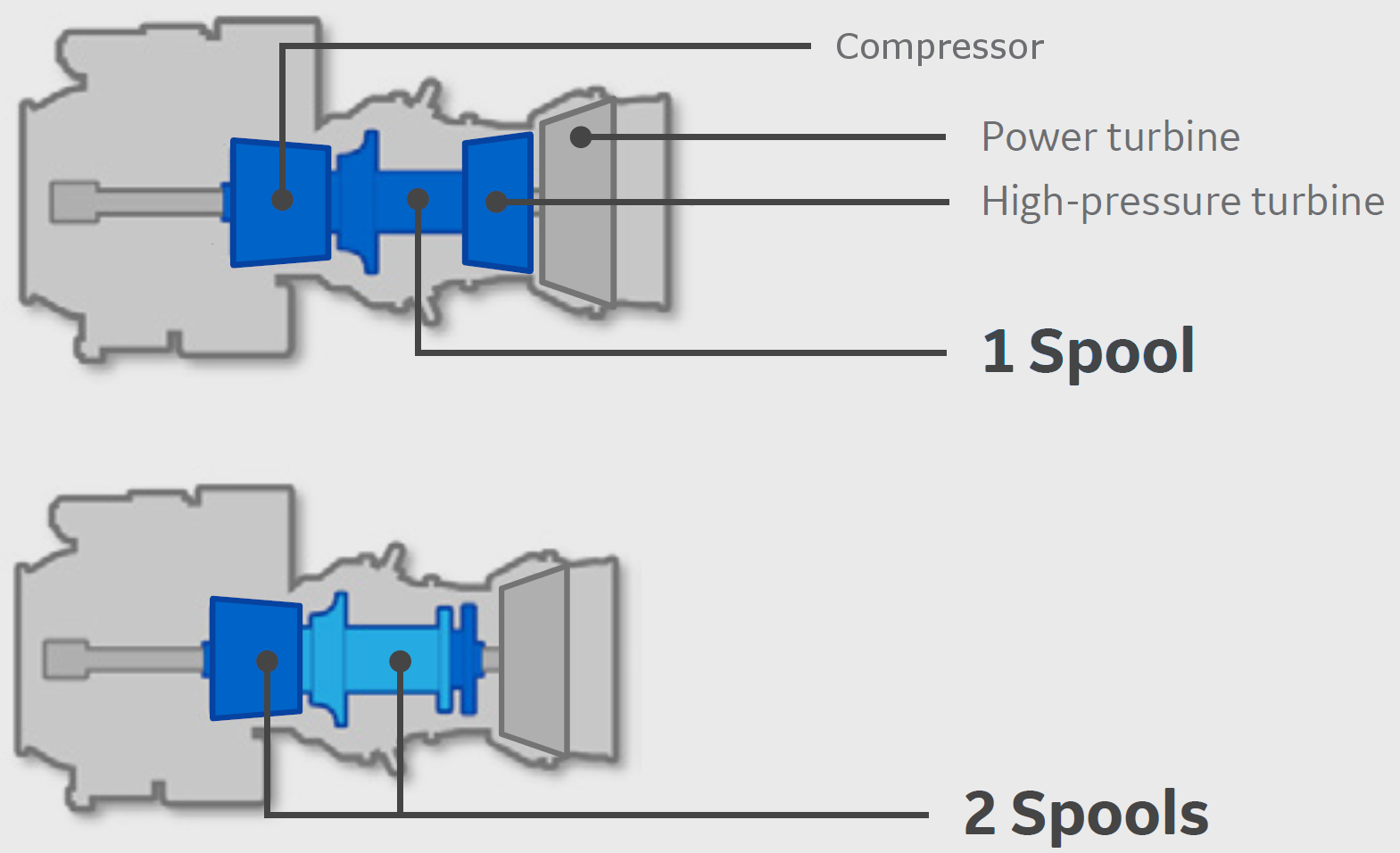 Single-spool engines have a single compressor-turbine “spool,” while dual-spool designs split the assembly into two compressor-turbine spools, each spinning independently. Source: GE Aviation
The two competing engine designs — single-spool and dual-spool — generate power according to the same fundamental principles, but differ in the complexity of their approach. Single-spool engines contain only one “spool” consisting of a compressor driven by a turbine; the entire spool assembly spins at the same speed. Dual-spool engines, in contrast, contain two compressor-turbine spools. Although mechanical complexity is greater in a dual-spool design, each section spins at a different speed, allowing it to operate at its most efficient design point.
Single-Spool Simplicity
GE said its single-spool design — dubbed the T901-GE-900 (or “T901”) — is more reliable due to fewer parts and a simpler design. Its engine incorporates additively manufactured components to reduce the overall number of parts and total weight. Ceramic matrix composites are used in the engine’s core to withstand higher temperatures; these advanced materials weigh less than metal parts, yet have greater durability. The T901 is also equipped with the latest inlet particle separation technology and durable erosion coatings to tolerate sand ingestion.
 GE’s potential T700 successor, the single-spool T901, would improve time on station for the Apache combat helicopter by 133% at a range of 100 km, increasing operation time at the mission location from 60 minutes to 139 minutes. Source: GE Aviation
[Learn more about ceramic matrix composites on Engineering360.]
[Discover wear resistant coatings on Engineering360.]
“Using GE’s industry leading technologies, rather than mechanical complexity, to meet ITEP requirements enables the use of a single-spool design, making the T901 engine less complex, less expensive, and lighter weight,” said Ron Hutter, executive director of the T901 program, in a press release.
The single-spool turbine configuration, GE points out, has proven its dependability with 40 years of combat experience on Black Hawk and Apache helicopters. Moreover, pilots and mechanics would not need to be retrained on the operational and maintenance differences that a dual-spool design would introduce.
The company said that the T901’s simpler modular design makes maintenance easier, facilitating quick engine disassembly and damaged module replacement. This enables a fix-forward capability in which engines can be repaired closer to the front to reduce the time required to return an asset to battle.
Overall, GE claims its single-spool T901 will have 10% cheaper acquisition costs and 45% lower maintenance costs compared to dual-spool designs.
GE contends that a dual-spool design adds weight and complexity to the engine with another frame, shaft and bearings required for the second spool. In addition to being more difficult to take apart for repairs, the company said that a higher part count will result in lower reliability as there are more points of potential failure.
Dual-Spool Efficiency
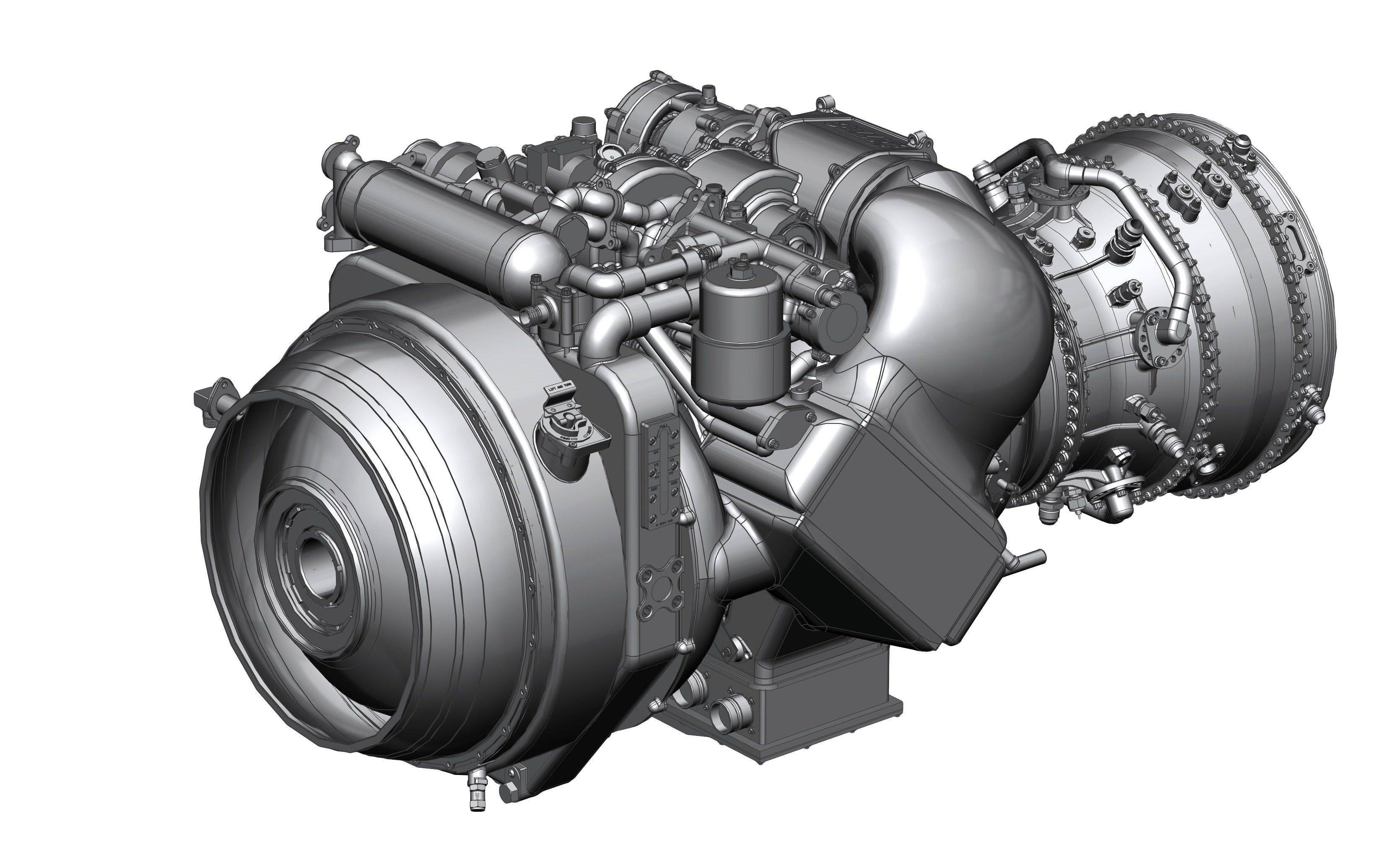 ATEC’s dual-spool T900 engine would provide a 50% payload increase over the T700, enabling Black Hawk helicopters to carry an additional five soldiers per mission. Source: ATECATEC counters that dual-spool engine architectures have a proven history of reliability dating to the 1950s in fixed-wing propeller and jet aircraft. The company said its dual-spool design — called the T900-HPW-900 (or “T900”) — is more dependable than a single-spool approach because it runs cooler. Dual-spool engines can generate higher pressure ratios while operating at lower core temperatures than single-spool engines. ATEC claims this prolongs engine life by reducing wear, and negates the need to rely on advanced materials that are unproven in the field.
The company said its dual-spool architecture results in more responsive control over engine power output. “The T900 will also have a world class engine control system that benefits from the most technologically advanced control systems used in the F-22 and F-35 fifth generation fighter aircraft. The lower inertia of the high-pressure system results in faster response to a pilot’s command for a change in power and in more rapid engine starts,” said Jerry Wheeler, vice president of ATEC, in a press release.
ATEC highlights the operating efficiency of its dual-spool architecture, claiming a 3 to 4% improvement in specific fuel consumption compared to competing single-spool engines. ATEC projects that 50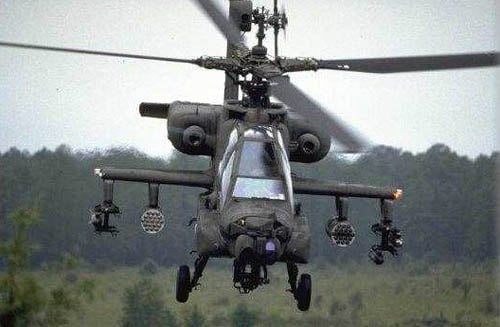 T700 engines will continue to power Apache helicopters through at least 2024, when a production decision is made by the Army on a successor engine. Source: U.S. Department of State million gallons in annual fuel savings combined with 20 to 35% lower production and maintenance costs will contribute to a total savings of $1 billion per year compared to the T700.
ATEC also claims there is room for an additional 10% growth in power in future design revisions with its dual-spool architecture compared to a single-spool option.
And the Winner Is?
Both GE and ATEC demonstrated their engine approaches during the Army’s Advanced Affordable Turbine Engine (AATE) program, the precursor to ITEP that kicked off in 2006. Each of the two engine designs successfully completed performance and durability tests, including sand ingestion trials.
The two companies have each submitted the second and final parts of their proposals to the Army’s Contracting Command for the Engineering and Manufacturing Development (EMD) phase of ITEP. A final decision is expected in early 2019 on which next-generation engine will replace the T700 in the years ahead.
Meanwhile, the T700 is not going anywhere anytime soon. Last year, GE Aviation won a contract from the U.S. Army worth up to $1 billion to manufacture as many as 2,500 additional T700 engines in support of ongoing operational requirements.
Editor's note: A previous version of this article stated that the Army is looking for a helicopter that will operate in temperatures of 95° C; this has since been corrected.

Author Eric Olson, on which hot planet is the Army planning to deploy these units?
"Army is looking for sustained performance at high altitude and in hot and sandy environments (6,000 ft and 95°C)".
Is this leaked evidence of a proposed invasion of Mars?
In reply to #1
Good catch! The Army is seeking sustained engine performance at ambient operating conditions of 95°F.
In reply to #1
It's for the invasion of Venus.
Mars is cooooooold as in freeze your ass off if you can find anything to breathe.