Novel Catalyst Could Help Bring This Fuel Cell to Your Home
David Wagman | October 29, 2018Researchers collaborating at a trio of universities have developed a fuel cell that runs on methane and operates at temperatures on par with automobile engines. They say that the low temperature could help cut the cost of materials for the device.
The fuel cell's newly invented catalyst makes its own hydrogen fuel from methane. Methane fuel cells usually require temperatures as high as 1,000° C to run, the researchers say. Their fuel cell, which is still in the lab, needs a temperature of about 500° C. That puts it on par with automobile combustion engines, which run at around 600° C.
The researchers say the lower temperature could trigger "cascading cost savings" in a range of ancillary parts needed to operate a fuel cell. Those cost savings could boost the cell's commercial viability. For example, stainless steel could be used to make interconnectors, which link together multiple fuel cells to increase their energy potential.
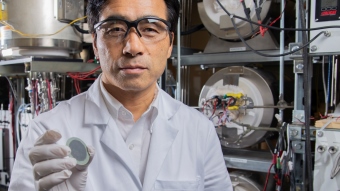 Meilin Liu holds the fuel cell that he and colleagues developed. Source: Georgia Institute of TechnologyThe researchers included Meilin Liu, Bote Zhao, Lei Zhang, Seonyoung Yoo, Kai Pei, Jun Hyuk Kim and Yong Ding of Georgia Institute of Technology; Yuechang Wei and Franklin Feng Tao of the University of Kansas; and Ziyun Wang and P. Hu of The Queen’s University of Belfast. Their work was published October 29 in the journal Nature Energy.
Addressing Oxidation
Above 750° C oxidation becomes an issue for metals. That factor often limits acceptable materials to certain metals that are often expensive and fragile, the researchers said. Lowering the temperature to 500° C "makes the mechanical engineer’s job much easier” in selecting viable materials.
 Close-up view of the fuel cell. Source: Georgia Institute of TechnologyThe fuel cell design also eliminates the need for a steam reformer, which normally converts methane and water into hydrogen fuel.
The research was based on solid oxide fuel cells (SOFCs), which are capable of using a range of fuels. Once commercialized, the researchers say the fuel cell stack would be about the size of a shoebox, not including ancillary technology needed to make it run, and could help power a home.
“The hope is you could install this device like a tankless water heater,” says Liu a professor of material science and engineering at Georgia Tech. "It would run off of natural gas to power your house."
New Catalyst
Hydrogen ranks among the best fuels for powering fuel cells, but its cost can be prohibitive. The researchers devised a new catalyst to convert methane to hydrogen. The catalyst is made with cerium, nickel and ruthenium and has the chemical formula Ce0.9Ni0.05Ru0.05O2, abbreviated as CNR.
When methane and water molecules come into contact with the catalyst and heat, nickel chemically cleaves the methane molecule. Ruthenium does the same with water. The resulting parts come back together as hydrogen (H2) and carbon monoxide (CO).
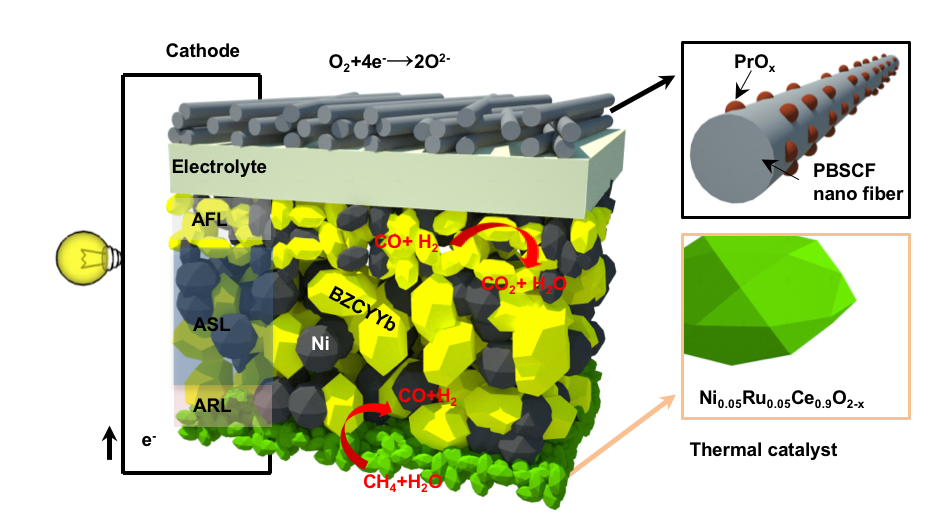 (Click to enlarge.) Schematic of fuel cell design. Source: Georgia Institute of TechnologyH2 and CO continue on to further catalyst layers that make up the anode, the part of the fuel cell that pulls off electrons, making the carbon monoxide and hydrogen positively charged ions. The electrons travel via a wire — creating the electricity flow — toward the cathode. There, electron-hungry oxygen attracts the electrons, closing the electrical circuit and becoming O2- ions.
Ionized hydrogen and oxygen meet and exit the system as water condensation. The carbon monoxide and oxygen ions combine to become pure carbon dioxide, which could be captured.
In some fuel cells, the water in the initial reactions must be introduced from the outside. In this new fuel cell, the researchers say that it is replenished in the last reaction phase, which forms water that cycles back to react with the methane.
The CNR catalyst was manufactured at the University of Kansas and is the outer layer of the anode side of the cell. It doubles as a protectant against decay, potentially extending the life of the cell.
On the cathode end, oxygen’s reaction and movement through the system are usually slow. Researchers working in the lab sped it up to raise the electricity output by using nanofiber cathodes, developed in a prior study.
The catalysts' structures, along with the nanofiber cathodes, enabled the researchers to reduce the operating temperature.
The work was funded by the Office of Basic Energy Sciences and the Advanced Research Projects Agency-Energy (ARPA-E), both in the U.S. Department of Energy. It was also funded by the National Science Foundation’s Division of Chemistry.