
An Alternative to Wasteful Methane Flaring
S. Himmelstein | August 03, 2017What do you see in this NASA photograph? A major city lighting up the night sky? 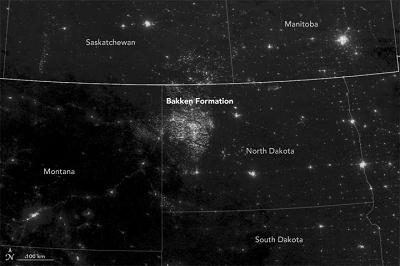 Bakken Formation methane flaring in North Dakota as seen from space. Image credit: NASA's Earth Observatory
It’s gas flares from oil and gas wells in North Dakota’s Bakken Formation, burning off methane and emitting as much greenhouse gas in a year as 1 million cars.
Oil companies burn off about one-third of the methane, recovered as a by-product, resulting in bright flares that can be seen from space. The practice accounts for 3.5 percent of the world’s natural gas consumption, according to U.S. and Russian researchers.
Washington State University engineers have devised an alternative to this wasteful flaring. They designed a small reactor that can be used in the field to decompose water and methane into carbon monoxide and hydrogen. In turn, the latter can be used for energy and industrial products.
The relatively low temperature process uses an inexpensive nickel catalyst in the presence of an electrical field to orient methane and water in a way that makes them easier to break apart. The reactor could also be attached to fuel cells that convert and store the energy as electricity.



The Coates Spherical Rotary Valve System (CSRV) replaces the traditional Poppet Valves and all their associated parts, springs, guides, seats, retainers, cotters, pushrods, cam followers, camshaft, camshaft bearings, and many more parts including the oil.
Animation: CSRV vs Poppet Valve
Plans are in the works to design and manufacture 150 KW, 200 KW, 250 KW, 500 KW, and 1,000 KW Coates CSRV industrial natural gas electric power generator sets that will be used in the oil and gas industry utilizing flare off gas that would otherwise be wasted and flared off into our atmosphere. This way it will lower the harmful emissions that are released into our atmosphere, create more profit for the company and produce much needed electric power. This is a win-win situation for everyone involved.
Coates International, Ltd. President and CEO, Mr. George J. Coates, comments: “We have the most advanced patented green engine technology in the world today. The oil and gas industry needs this advanced CSRV technology right now. Here at Coates, we are working diligently to produce large numbers of CSRV industrial natural gas generator sets in China and in the USA to supply our customers in the oil and gas industry. Much progress is being made and we are forging ahead on all fronts with new castings, new components and parts which are in the manufacturing process.