Study on CVT Pump Efficiency Proposes New Hydraulic Scheme
Shawn Martin | October 19, 2018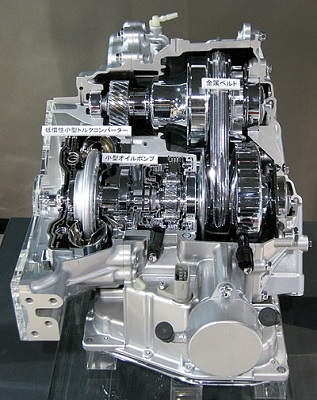 A cutaway photograph of Toyota Super CVT-i (continuously variable transmission).A research paper published in Mechanism and Machine Theory proposes a new hydraulic scheme that improves the hydraulic pump efficiency within an automobile's continuously variable transmission (CVT).
Researchers at the State Key Laboratory of Advanced Design and Manufacturing for Vehicle Body of Hunan University in Changsha, China, developed a new hydraulic scheme that reduces hydraulic pump power losses of a continuously variable transmission (CVT). This is accomplished by diminishing the inlet and outlet pressure differential and reducing excess pump displacement.
The report cites the fuel economy of a vehicle equipped with CVT fails to meet its potential due to lower than expected transmission efficiency. The observed efficiency of a CVT is in the range of 75% to 90% and power losses are attributed to both the speed change mechanism and the associated hydraulic system.
While many studies have addressed CVT efficiency by optimizing the CVT speed ratio, this new study took a different approach. It found that by reducing pump power losses in the CVT’s hydraulic pump, vehicle fuel consumption was greatly reduced.
The researchers stated that “power loss of the hydraulic system can be reduced by diminishing the inlet and outlet pressure difference of the pump, thereby reducing the pump displacement and improving the mechanical efficiency of the pump, when the pump driving speed of oil pump is constant. The efficiency of the hydraulic system is enhanced by changing the effective displacement of the pump and decreasing the inlet and outlet pressure difference of the pump.”