New Frontiers for THz
Tony Pallone | September 03, 2018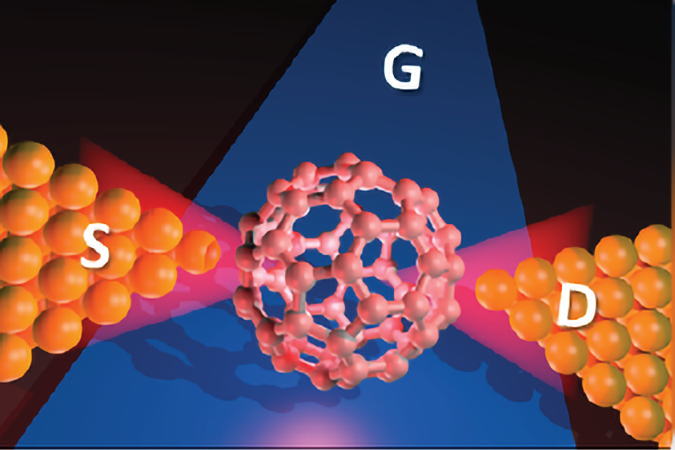 Illustration of single-molecule transistor with bowtie antenna structure (S, D and G indicate the source, drain and gate electrodes). Source: 2018 Kazuhiko Hirakawa, Institute of Industrial Science, The University of TokyoA new study led by the University of Tokyo's Institute of Industrial Science (IIS) could open up the wider use of terahertz spectroscopy, with applications in nanoelectronics and quantum computing.
Spectroscopy deals with the interaction of matter and electromagnetic radiation. A wide range of wavelengths can be used to stimulate vibrations, electron transitions and other processes in order to probe the world of atoms and molecules.
But a terahertz (THz) radiation, a lesser-used type lying on the electromagnetic spectrum between infrared and microwaves, is impossible to focus onto a single molecule with conventional optics because of its long wavelength.
The IIS scientists found a way around that with a single-molecule transistor (SMT), a nanoscale design made from adjacent metal electrodes placed in a “bowtie” shape. Those electrodes act as antennae to tightly focus a THz beam onto isolated molecules.
For their study, the team used molecules of C60 fullerene, also known as buckyballs. "The fullerenes absorb the focused THz radiation, making them oscillate around their center-of-mass," explained study first-author Shaoqing Du. "The ultrafast molecular oscillation raises the electric current in the transistor, on top of its inherent conductivity." That current change is minuscule, but it can be precisely measured with the same electrodes used to trap the molecules. In fact, the measurement is sensitive enough to detect the addition or subtraction of a single electron.
The vibrational quantum, or vibron, of the molecule can be absorbed by an electron in the metal electrode; the electron then tunnels into the C60 molecule, causing it to vibrate at a slightly lower frequency — and thus absorbing a different frequency of THz radiation.
In addition to providing a glimpse of tunneling, the IIS study demonstrates a practical method to obtain electronic and vibronic information on molecules that only weakly absorb THz photons.
The research appears in Nature Photonics.