The Life Expectancy Impacts of Particulate Matter Pollution
S. Himmelstein | August 24, 2018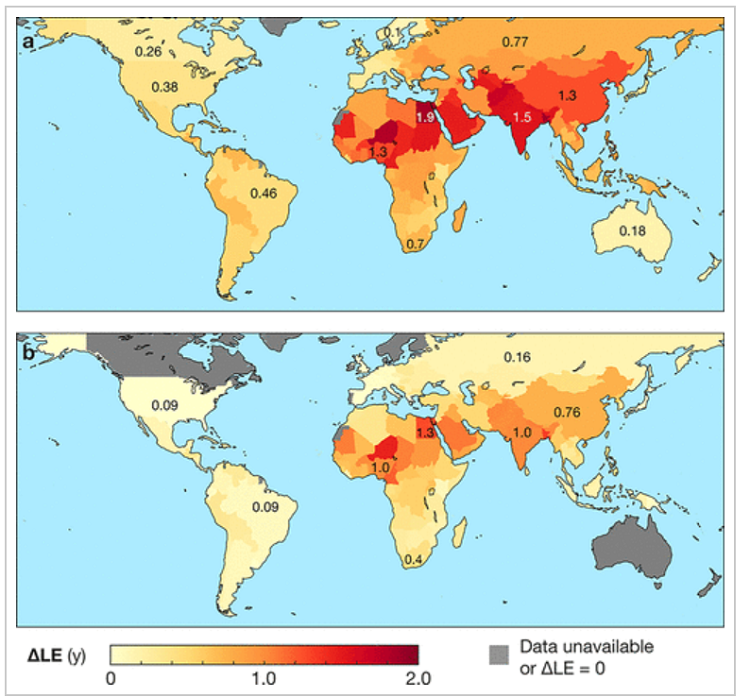 Global maps of the life expectancy decrement ΔLE from PM2.5. Panel a shows baseline ΔLE for year-2016 concentrations (global population-weighted mean and median of 1.03 and 1.22 years, respectively). Panel b shows hypothetical gains in life expectancy for an alternative exposure distribution where concentrations are limited to a maximum of 10 μg m–3, the WHO air quality guideline concentration (global-average ΔLE of ∼0.59 year). Source: University of Texas at Austin
Outdoor air pollution from particulate matter (PM) smaller than 2.5 microns can enter deep into the lungs, and breathing PM2.5 is associated with increased risk of heart attacks, strokes, respiratory diseases and cancer. An even more dire impact has been documented by researchers from the University of Texas at Austin: such pollution shortens human lives by more than a year.
Data from the Global Burden of Disease Study were used to measure PM2.5 air pollution exposure and its consequences in 185 countries. The national impact on life expectancy was then quantified for each nation and on a global scale.
A reduction of life expectancy of 0.38 year in the U.S. due to PM2.5 exposure is substantially larger than the impact of breast cancer (0.23 year), while in South Asia, the life expectancy decrement for PM2.5 (1.6 years) substantially exceeds the combined impact of all cancers.
Life expectancy could increase by an estimated population-weighted median of 0.6 year if PM2.5 in all countries met the World Health Organization Air Quality Guideline of 10 μg m–3, a benefit of a magnitude similar to that of eradicating lung and breast cancer.
The research is published in Environmental Science & Technology Letters.