Recycling India's Floral Waste
Marie Donlon | August 21, 2018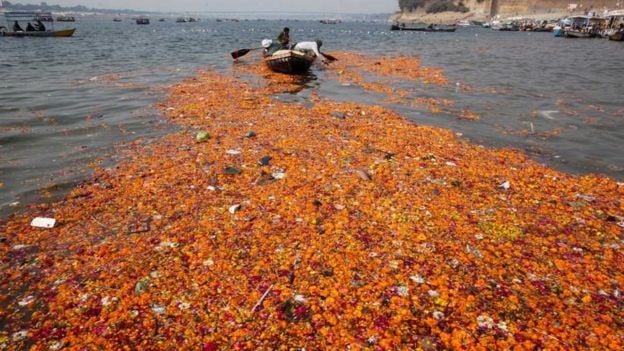 Source: Parimala ShivaprasadInspired by the number of flowers discarded after use in religious ceremonies throughout India, a Bangalore native and chemical engineer has an entirely new vision about how to use the flowers instead of dumping them in landfills or in the country's already polluted waters.
Parimala Shivaprasad’s vision involves enabling temples in India to collect essential oils from flowers and using the residue for organic compost to grow vegetables to help feed the hungry.
"I want to collect the floral waste and extract the essential oils from the fragrant part, the biomass, and then compost the rest of the biomass to produce organic manure, looking at completely recycling the flower waste," said Shivaprasad, who is currently a postgraduate student at the University of Bath.
That manure could be used by small households or even the temples on their vegetable patch, because usually temples tend to feed people on a daily basis.
"Flowers from religious places cannot really be combined with normal waste," she said.
"Where [temples] have access to rivers and lakes, they tend to dispose of them in flowing waters because that is considered holy.
"Otherwise, they try and get them into the land fills, but if it cannot be combined with the waste it is dumped on open ground and this has led to a lot of pollution in rivers and lakes and on land," Shivaprasad concluded.
Contributing to the growth of algae, which can deplete oxygen levels and thus threaten marine life, organic matter from dying flowers can also cause problems on land.
As such, Shivaprasad has developed lab equipment that would enable temples to collect essential oils from the discarded flowers.
"The early idea is to scale up the lab equipment I have to accommodate about five kilos of flower petals to work with on a daily basis and run the extraction unit for about eight hours a day," she said.
To start, Shivaprasad will conduct a pilot study of the scheme at a temple in Bangalore. If successful, she plans to expand the trial to include more temples.
"Seeing so much floral waste in India — and because I was a chemical engineer — I thought the two could come together and make something useful," said Shivaprasad.