Scientists Reveal Possible Method for Removing CO2 from the Atmosphere
Marie Donlon | August 15, 2018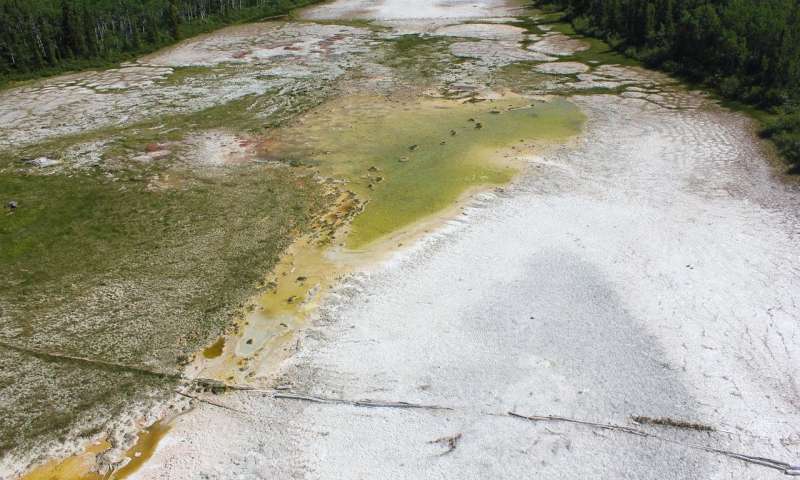 Magnesite sediments in a playa in British Columbia, Canada. Source: Ian PowerIn search of a method for removing carbon dioxide (CO2) from the atmosphere, thereby slowing the rate of global warming, a team of scientists led by Professor Ian Power of Trent University, Ontario, Canada, has discovered a possible solution.
Presenting their work at the Goldschmidt conference in Boston, the team detailed a process for rapidly producing magnesite, which is a mineral that stores carbon dioxide. If the team can develop this into an industrial-scale process, the potential for removing CO2 from the atmosphere for long-term storage improves the possibility of reversing the global warming fallout of atmospheric CO2.
By accelerating the formation of magnesite, which is typically a very slow process, researchers believe that the amount of CO2 removed from the atmosphere could be significant considering that a tonne of naturally occurring magnesite could remove roughly half a tonne of CO2 from the atmosphere.
Project leader, Professor Ian Power (Trent University, Ontario, Canada) said, "Our work shows two things. Firstly, we have explained how and how fast magnesite forms naturally. This is a process which takes hundreds to thousands of years in nature at Earth's surface. The second thing we have done is to demonstrate a pathway which speeds this process up dramatically."
The team demonstrated that by using polystyrene as a catalyst, magnesite could form within just 72 days.
"Using microspheres means that we were able to speed up magnesite formation by orders of magnitude. This process takes place at room temperature, meaning that magnesite production is extremely energy efficient," explained Professor Power.
"For now, we recognise that this is an experimental process, and will need to be scaled up before we can be sure that magnesite can be used in carbon sequestration (taking CO2 from the atmosphere and permanently storing it as magnesite). This depends on several variables, including the price of carbon and the refinement of the sequestration technology, but we now know that the science makes it do-able," concluded Professor Power.
Commenting on the process, Professor Peter Kelemen at Columbia University's Lamont Doherty Earth Observatory (New York) said "It is really exciting that this group has worked out the mechanism of natural magnesite crystallization at low temperatures, as has been previously observed — but not explained — in weathering of ultramafic rocks. The potential for accelerating the process is also important, potentially offering a benign and relatively inexpensive route to carbon storage, and perhaps even direct CO2 removal from air."