Soil Not as Good a Carbon Sink as Thought, Study Says
John Simpson | September 28, 2016The ground will absorb far less atmospheric carbon dioxide this century than previously thought, say environmental scientists from the University of California, Irvine (UCI).
Researchers led by Earth System Science Professor James Randerson used carbon-14 data from 157 sample sites around the world to determine that current soil carbon is about 3,100 years old, and not the 450 years stipulated by many Earth system models.
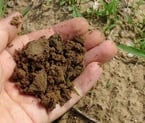 Current soil carbon is about 3,100 years old, and not the 450 years stipulated by many Earth system models. Image source: Pixabay.“This work indicates that soils have a weaker capacity to soak up carbon than we have been assuming over the past few decades,” Randerson says.
Through photosynthesis, plants absorb CO2 from the air. When trees and vegetation die and decay, they become part of the soil, effectively locking carbon on or beneath the Earth’s surface, and keeping it out of the atmosphere, where it could contribute to global warming. In their study, the researchers showed that since this process unfolds over millennia, rather than decades or centuries, we should expect less of this land carbon sequestration in the 21st century.
“A substantial amount of the greenhouse gas that we thought was being taken up and stored in the soil is actually going to stay in the atmosphere,” says Steven Allison, associate professor of ecology and evolutionary biology and earth system science.
In recent years, scientists have used complex, computer-based Earth system models—compilations of code integrating data on the planet’s oceans, land surfaces, ice masses, atmosphere, and biological systems—to draw conclusions about potential future changes in regional and global temperatures, drought, sea levels, and other phenomena.
The models don’t explicitly provide the age of carbon in soils. However, Yujie He, a postdoctoral scholar when the UCI study was conducted, says that she and her colleagues figured out a way to improve them through simplification and the addition of dating methods well established in the scientific community.
The authors say that adding more carbon to that which has been in the ground for thousands of years is problematic given the pace at which the Earth seems capable of integrating it.
“If we waited 300, 400, 1,000 years, then that carbon—we think—would go into the soil. But that’s not going to help us in dealing with climate change, which is happening now," Allison says.