Father-Son Team Invents 3D Medical Scanner
Tony Pallone | August 06, 2018 The father-and-son team of Anthony (left) and Phil Butler (right), inventors of the MARS spectral X-ray scanner. Source: University of Otago, Christchurch
A revolutionary 3D color medical scanner that offers unprecedented detail of the body’s chemical components has been invented by a father and son team of scientists in New Zealand.
The duo, Phil and Anthony Butler, created their MARS spectral X-ray scanner using the same particle detector technology developed at the European Organization for Nuclear Research (CERN) and used in the search for the Higgs boson particle. Its Medipix3 technology measures the energy of each X-ray photon as it is detected, which is then used to produce three-dimensional images of the constituents of the subject. Traditional black-and-white X-rays only measure an object’s shape and density.
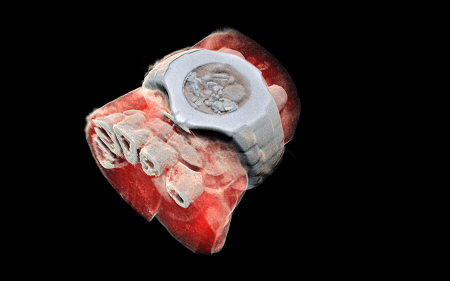 An image of Prof. Phil Butler's wrist, produced by the MARS scanner. Source: MARS Bioimaging Ltd."As a new imaging device, a new microscope if you like, biomedical researchers can non-invasively see different kinds of detail inside patients," said Phil Butler, a physics professor at New Zealand’s University of Canterbury (UC).
Those details include fat, water, calcium and disease markers, according to Anthony Butler, a radiologist and professor at the Universities of Otago and Canterbury. A small version of the MARS scanner has been used by researchers “to study cancer, bone and joint health and vascular diseases that cause heart attacks and strokes,” Butler added.
The device has the potential to revolutionize medical imaging globally, enabling more accurate diagnoses and personalization of treatments. In the next few months, the MARS scanner will be used to scan orthopedic and rheumatology patients in a world-first clinical trial, although the first human has already been scanned: professor Phil Butler himself, who allowed his ankle and wrist to be imaged.
Anthony Butler said that the device has been in development for a decade, and that it is now at a point where it could begin to be used for routine patient care. The Butlers have set up a company, MARS Bioimaging Ltd., to commercialize the scanner.