UBC Engineers Develop Method for Breaking Down 'Fatbergs'
Marie Donlon | August 02, 2018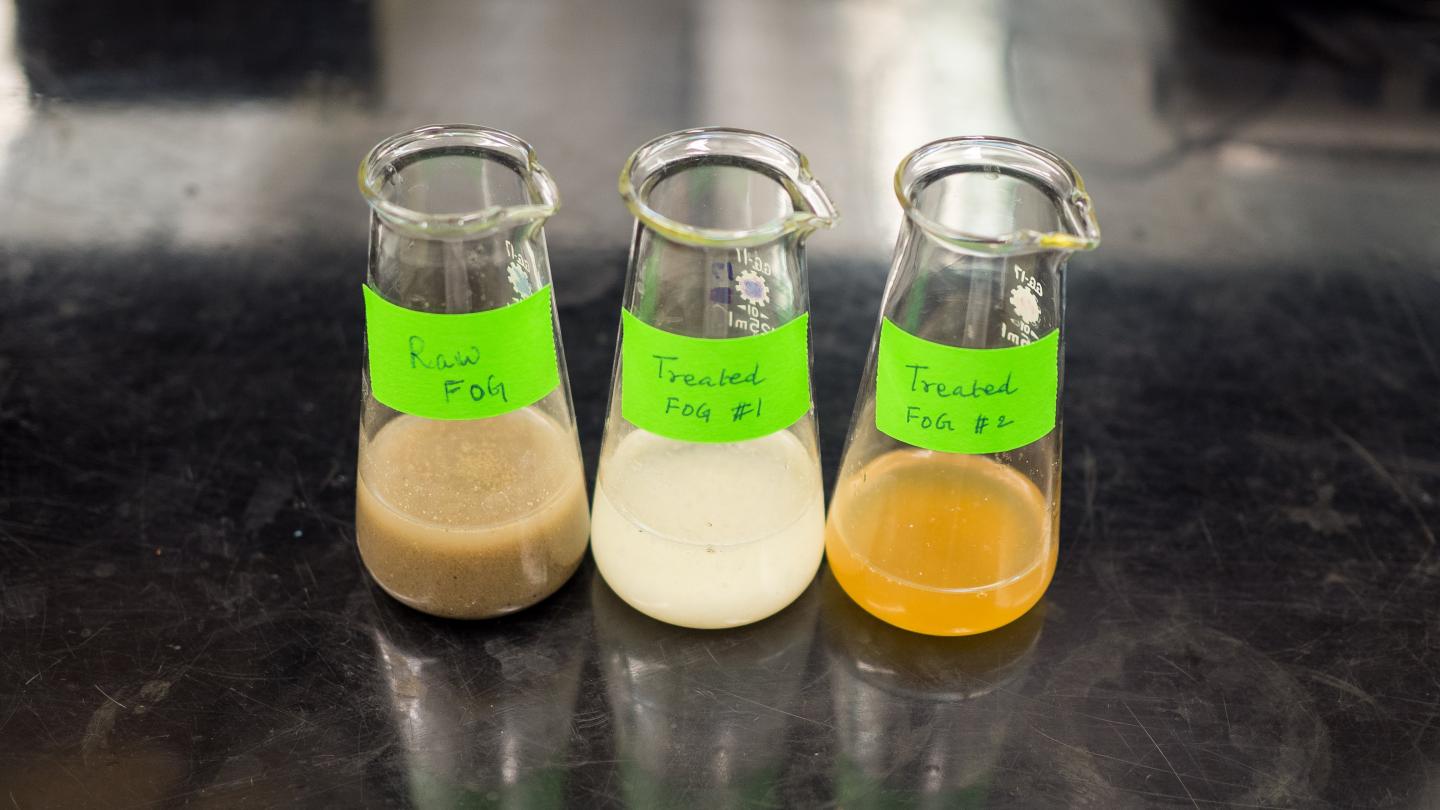 A UBC method to break down fats, oil and grease can be used in municipal FOG management programs. Source: Clare Kiernan/UBCFatbergs — deposits of cooking oil and similar waste that gathers and solidifies, clogging pipes and in some instances blocking sewage systems — may now be treated and turned into energy thanks to research from the University of British Columbia.
To break down the fats, oils and grease, called FOG, researchers heated the FOG between 90° and 110° C while adding hydrogen peroxide to the mix. Hydrogen peroxide, according to the research, is a chemical that encourages the breakdown of organic matter. As such, the treatment cut the volume of solids in the FOG by roughly 80 percent. Additionally, the treatment also released fatty acids from the mix that can be broken down during the next stage by bacteria.
"FOG is a terrific source of organic material that microorganisms can feed on to produce methane gas, which is a valuable, renewable energy source. But if it's too rich in organics, bacteria can't handle it and the process breaks down. By preheating it to the right temperature, we ensure that the FOG is ready for the final treatment and can make the maximum amount of methane," says research associate Asha Srinivasan.
According to Srinivasan, such treatments might be adopted by farmers who will be able to load more FOG into biogas digesters (the tanks that hold and treat farm waste such as cow manure to make methane).
"Farmers typically restrict FOG to less than 30 per cent of the overall feed. But now the FOG can be broken down into simpler forms, so you can use much more than that, up to 75 per cent of the overall feed. You would recycle more oil waste and produce more methane at the same time."
The method is expected to be used primarily in municipal FOG management programs, said lead researcher Victor Lo, emeritus professor of civil engineering at UBC.
"The principle would be the same: you pretreat the FOG so it doesn't clog the pipes, and add it to sewage sludge to produce methane from the mix.
"To the best of our knowledge, this type of pretreatment for FOG has not been studied before, although simple chemical methods do exist to break down FOG," added Lo. "We're hoping to do more research to find the optimal ratio of FOG to dairy manure so that they can be pretreated together."
The research is published in the journal Water, Air & Soil Pollution.