Prosthetic Heart Valve Design Inspired by Dragonfly Larvae
S. Himmelstein | July 28, 2018To build a better heart valve, watch the movement and respiration of dragonfly larvae.
Researchers from California Institute of Technology have observed that larvae of the Anisopteran dragonfly, which live in water and both breathe and move by inhaling it, extract oxygen before expelling the water back out through a tri-leaflet anal valve that is surprisingly similar in structure to tricuspid human heart valves.
The larvae control the retraction of each of the three leaves individually, giving them fine control over the 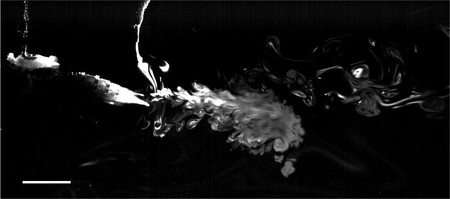 Seen as a light-colored plume, water jets out from the back of a larval dragonfly. Source: Chris Roh and Mory Gharib/California Institute of Technologysize and symmetry (or asymmetry) of the valve opening.
High-speed cameras were installed around an aquarium to monitor how larvae directed the flow of water using the leaves on their anal valves. After the aquarium was filled with a colored dye, the researchers used dental wax to tether 96 dragonfly larvae — one at a time — in front of the cameras. They noted that when the larvae retracted all three leaves, the water jet flows straight out, pushing the animals straight forward. Retracting just one or two leaves results in an asymmetric flow, which the larvae use when breathing.
Since heart valves also have two or three leaves (depending on the valve) that control the flow, the researchers will use their knowledge of dragonfly larvae propulsion to design a new prosthetic multi-leaf heart valve. The new device will be able to direct jets in specific directions that mimic natural blood flow emerging from the valve, which is never perfectly symmetric. Currently, the unnaturally symmetrical flow of blood emerging from prosthetic valves can cause blood clots to form or even be abrasive to the walls of blood vessels. To cope with this unintended side effect of prosthetic heart valves, patients typically face the prospect of taking blood-thinning drugs for the rest of their lives.
An intentionally off-centered opening of the heart valve to more closely match the patient's original blood flow is expected to be an important design parameter that can be adjusted based on each patient's heart morphology.
The research is published in the journal Bioinspiration & Biomimetics.