Bone Replacements are 3D Printed
Engineering360 News Desk | May 09, 2016The need for replacement facial and head bones is large, with an estimated t 200,000 people in the U.S. requiring replacement facial and head bone implants as a result of surgery, trauma or birth defects. Surgeons typically remove bone from the patient's leg, sculpting it into the desired shape. This procedure, however, can lead to complications and implant imperfections, prompting scientists at Johns Hopkins University to improve the process.
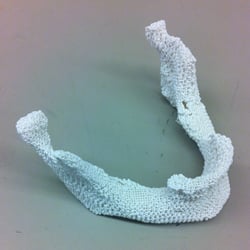 A 3d printed scaffold for a lower jaw implant. Image source: Johns Hopkins UniversityA composite material for implant fabrication was developed by additive manufacturing. Polycaprolactone (PCL), a biodegradable polyester, was combined with bone powder derived from pulverizing decellularized porous bone inside cow knees. The plastic component lends strength and printability traits while the natural bone imparts the biological cues to support the plastic scaffolds.
Tests were conducted with different bone powder blend concentrations and human fat-derived stem cells. After three weeks, cells grown on 70% bone powder scaffolds showed gene activity hundreds of times higher in three genes indicative of bone formation compared to cells grown on pure PCL scaffolds. The 30% bone powder scaffolds showed large, but less impressive, increases in the same genes.
After addition of the bone growth stimulant beta-glycerophosphate, cells on 30% scaffolds produced about 30% more calcium per cell. Those on 70% scaffolds produced more than twice as much calcium per cell, compared to those on pure PCL scaffolds.
Further, a 12-week trial showed that mice with stem cell-infused scaffold implants had new bone growth within large holes in their skull bones made experimentally. At least 50% more bone grew in scaffolds containing 30% or 70% bone powder, compared to those with pure PCL.