How Luck Ran Out in Vegas for This Overseas Flight
Engineering360 News Desk | June 21, 2018A 2015 engine fire on a British Airways 777-236ER was caused by a fatigue crack in the high-pressure compressor stage 8 disk web and subsequent uncontained engine failure, which led to the detachment of the main fuel supply line, said the U.S. National Transportation Safety Board (NTSB) in a final accident investigation report.
 The Sept. 8, 2015 fire occurred during the takeoff roll at McCarran International Airport in Las Vegas. Two seconds after hearing a “bang,” the captain aborted the takeoff. The jetliner came to a stop on the runway 13 seconds later. The 157 passengers, including one lap child, and 13 crew members evacuated via emergency slides. One person was seriously injured and 19 suffered minor injuries. The flight’s destination was London-Gatwick Airport.
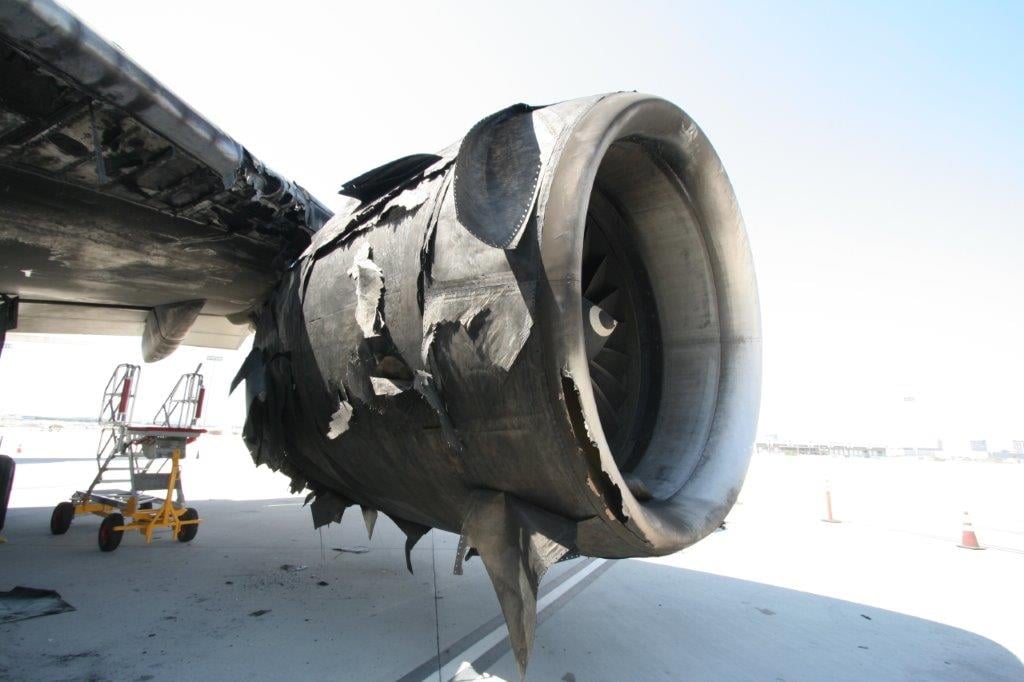 (Click to enlarge.) Fire-damaged engine. Credit: NTSBThe report says that the high-pressure compressor stage 8-10 spool in the left engine, one of two GE GE90-85BG11 engines on the airplane, had accumulated 11,459 total cycles. Investigators found that the crack initiated after about 6,000 cycles, much earlier than the engine’s manufacturer, GE, predicted; the cause of the crack initiation could not be identified. There were no additional cracks found on the disk during a post-accident inspection of the engine.
The disk web was not an area that either the Federal Aviation Administration or the manufacturer required to be inspected, so the crack went undetected. During maintenance in September 2008, when the high-pressure compressor was removed from the engine and disassembled, exposing the stage 8-10 spool, the surface crack length would have been about 0.05 in.
 (Click to enlarge.) Diagram showing fracture location. Credit: NTSB“If the disk web had been required to be inspected during this maintenance, the crack should have been detectable,” the report says. The lack of inspection procedures for the stage 8 disk contributed to the accident, the NTSB found. After the accident, GE implemented inspection procedures designed to detect disk web cracks.
The report also found that the captain ordered passengers to evacuate from the right side of the airplane. But the NTSB found that the unaffected right engine continued to run for 43 seconds after the captain’s order, resulting in jet blast blowing two emergency slides out of position and rendering them unusable for the evacuation. The passengers and crew were able to use two of the eight doors to leave the airplane before smoke and fire encroached the fuselage.
The NTSB found that the captain did not use his quick reference handbook to read and do checklist items. It was only when a third pilot in the cockpit noticed instruments indicating the right engine was still running that the engine was shut down.
A Bang, then a Veer to the Left
The British Airways Boeing 777-236ER had started its takeoff ground roll at McCarran International Airport. During the roll, the cockpit voice recorder (CVR) recorded a "bang" sound. Immediately afterward, the airplane veered to the left and the CVR recorded the engine indicating and crew alerting system (EICAS) aural annunciation "engine fail." The captain moved the thrust reverser levers to their idle positions and began the rejected takeoff maneuver.
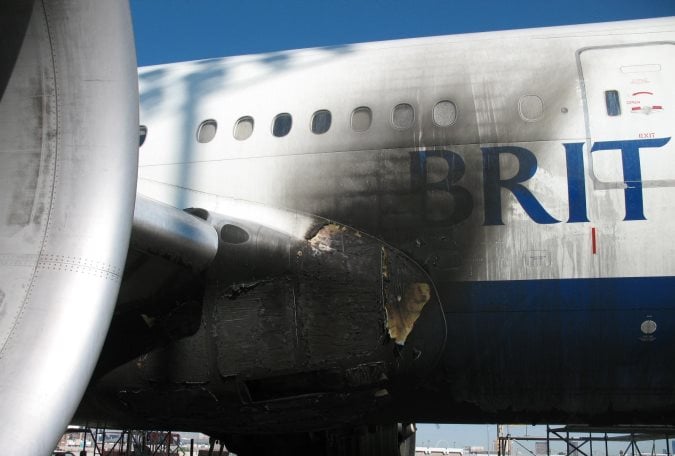 (Click to enlarge.) Fire scorch marks on aircraft fuselage. Credit: NTSBThe airplane's airspeed at the time of the rejected takeoff maneuver was about 77 knots, the NTSB says. The start of the rejected takeoff maneuver occurred 2 seconds after the "bang" sound, and the airplane came to a stop 13 seconds after the rejected takeoff maneuver began. The captain made a timely decision to reject the takeoff well before the takeoff speed of 149 knots, and performed the maneuver in accordance with company training and procedures, the report says.
The report says the uncontained left engine failure resulted from a fatigue crack in the high-pressure compressor (HPC) stage 8 disk. The fatigue crack started on the aft face of the disk web and progressed through the web and in the circumferential direction. The fracture region had an intergranular appearance near the aft face of the web and a transgranular appearance farther away from the initiation site. The transgranular area exhibited striations consistent with low-cycle fatigue crack growth.
 Interior damage at Row 11. Credit: NTSBThe report says that GE considered worst-case conditions (highest stresses and temperatures and minimum material properties) in predicting the low-cycle fatigue crack initiation lifetime at the stage 8 disk aft web faced and found that it had a low-cycle fatigue initiation life of about 29,800 cycles.
The HPC stage 8-10 spool had accumulated 11,459 total cycles and the low-cycle fatigue crack had propagated over approximately 5,400 of those cycles, the balance was the number of cycles for crack initiation, approximately 6,000 cycles. Thus, NTSB says that GE's predicted crack initiation life (low-cycle fatigue life) at the aft web face was approximately five times greater than the estimated crack initiation life at the aft web face of the accident disk.