Watch: Stretching the Limits with an Electrically Conductive Hydrogel
S. Himmelstein | June 20, 2018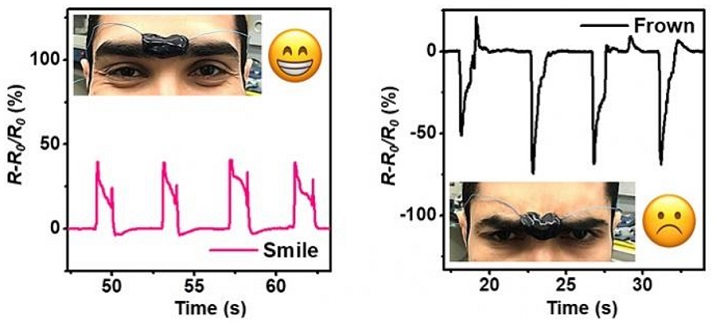 Signals from the electrically conductive hydrogel can clearly distinguish between different facial expressions. Source: KAUST
An electrically conductive hydrogel engineered at King Abdullah University of Science and Technology (KAUST), Saudi Arabia, is predicted to be of value in biosensing and biomedical applications. The material, which is a composite of hydrogel and MXene metal carbide, is claimed to take stretchability, self-healing and strain sensitivity to new limits.
The smart material can stretch by more than 3,400 percent and quickly return to its original form. It also adheres to a number of surfaces, including skin. When cut into pieces, it quickly heals itself upon reattachment.
The electrically conductive hydrogel could be of use in applications that sense changes in the skin and convert them into electronic signals. A thin slab of the material attached to a user’s forehead, for example, can distinguish between different facial expressions, such as a smile or a frown, providing the ability for patients with extreme paralysis to control electronic equipment and communicate.
Material strips attached to the throat have impressive abilities to convert speech into electronic signals and might allow those with speech difficulties to be clearly heard.
The research is published in Science Advances.