Computational Modeling for Treating Alzheimer's Disease
Tony Pallone | May 24, 2018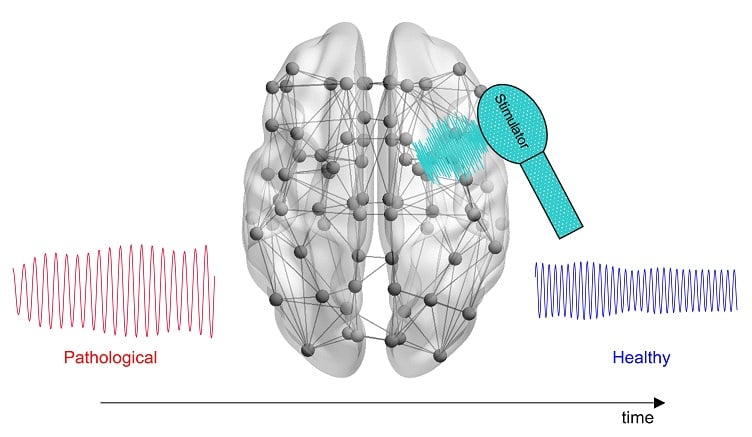 Researchers have incorporated individual neuroimaging data into computationally-tuned brain stimulation. Source: Lazaro Sanchez-Rodriguez, partially using BrainNet Viewer.
A new computational tool incorporating individual patients' brain activity could help optimize treatment of Alzheimer’s disease.
The treatment relies upon electrical stimulation of certain parts of the brain to promote healthy neural circuit activity, an experimental approach that has shown some promise in clinical trials. In current trials, however, patients are receiving identical treatment protocols; the new approach would allow personalization.
To explore the viability of personalized treatment, Lazaro Sanchez-Rodriguez of the University of Calgary, Canada, and colleagues built a computational tool that incorporates patients' MRI scans and physiological brain signaling measurements. It then calculates optimal brain stimulation signals, with the goal of delivering treatment efficiently and effectively.
The approach is based on a computational strategy known as the state-dependent Riccati equation control (SDRE). It has been applied in other fields, such as aerospace engineering, to optimize input signals that control dynamic, nonlinear systems. The human brain is a system that also fits that description; the strategy enabled the new tool to reveal which brain regions would, or would not, be likely to benefit from stimulation.
They found that certain parts, like the limbic system and basal ganglia structures, could serve as particularly powerful stimulation targets. They also found that patients whose neural structures are highly integrated in the brain network may be the most suitable candidates for stimulation.
"With our new framework, we are getting closer to erasing the knowledge gap between theory and application in brain stimulation," Sanchez-Rodriguez said. "I think we will soon see a boom in the application of our framework and similar tools to study other diseases involving impaired brain activity, such as epilepsy and Parkinson's."
Next, the researchers plan to refine their tool so that it accounts for additional variation in brain activity between patients.
The research can be found in the May 24, 2018, edition of PLOS Computational Biology.