
Personal Care Products Pollute Urban Air
S. Himmelstein | May 01, 2018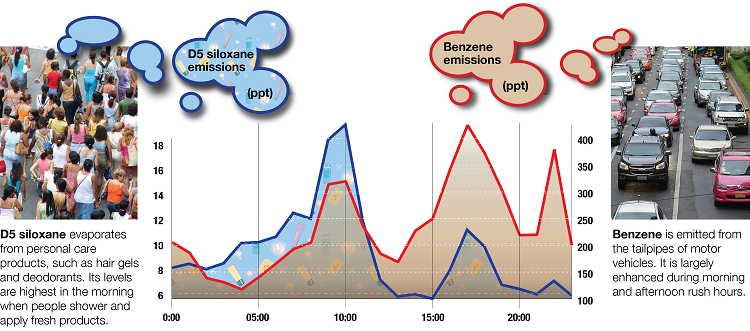 Source: Kathy Bogan/CIRESIt would be difficult to imagine modern civilization without shampoo, deodorant and other personal care products. Use of these products may help us feel and smell clean, but they’re also agents of environmental pollution. An emerging body of research finds emissions from personal care products are important sources of urban air quality degradation.
A study conducted by researchers from the U.S. National Oceanographic and Atmospheric Administration and the Cooperative Institute for Research in Environmental Sciences documented elevated concentrations of siloxane, a common ingredient in shampoos, lotions and deodorants in the atmosphere of Boulder, Colo. Siloxane emissions were found to be comparable in magnitude to the emissions of vehicle exhaust components, such as benzene, from rush-hour traffic in the city.
After monitoring air pollution indicators with stationary and mobile measurement systems, the researchers observed a notable peak in the data that was ascribed to siloxane. Maybe it was a component of vehicle exhaust, since the siloxane emissions correlated with benzene emissions from traffic. However, analysis of tailpipe emissions and roadside measurements revealed no vehicular source for the volatile organic compound (VOC).
But a link between benzene and siloxane was identified: commuting.
By studying their data hour-by-hour, they realized siloxane emissions peaked in the morning, which is when personal care products are used prior to the daily commute. Benzene emissions also increased in the morning, and emissions of both declined during the day and peaked again during the evening commute. The evening peak of siloxane emissions was lower than in the morning, since the personal care products had largely evaporated throughout the day.
The researchers concluded that as transportation emissions of VOCs have declined, other sources of VOCs, including from personal care products, are emerging as important contributors to urban air pollution.
Our tax dollars, hard at work.