New U.S. Wind Turbine Database Released
S. Himmelstein | April 21, 2018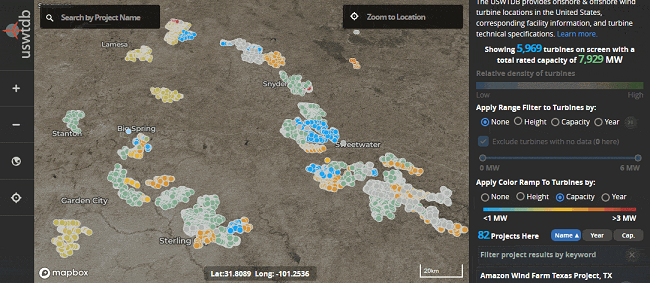 The United States Wind Turbine Database is unprecedented in its ability to search and sort the U.S. wind turbine fleet. Source: Lawrence Berkeley National Laboratory
Lawrence Berkeley National Laboratory, in collaboration with public and private partners, has released the most comprehensive publicly available database yet of U.S. wind turbine locations and characteristics. The United States Wind Turbine Database (USWTDB) will greatly enhance the ability of government agencies and others to make planning decisions.
The USWTDB was funded by the U.S. Department of Energy’s Wind Energy Technologies Office and developed as part of a public-private partnership with the American Wind Energy Association and in collaboration with the U.S. Geological Survey (USGS). The system will be regularly updated more often than existing publicly available wind turbine datasets.
Federal agencies will be able to share data to properly account for wind plants in development planning. The U.S. Departments of Defense and Homeland Security and the National Oceanic Atmospheric Administration have been using the database already to perform crucial operational impact assessments of wind turbines on radar. Other examples of uses for the data include studying wind energy and wildlife interactions, reviewing economic impacts assessments of wind energy’s deployment and better understanding of local wind deployment trends.
With the release of the USWTDB, data that were previously scattered across many datasets and in some cases unavailable to the public have been released to the public in a single package. It currently contains data from more than 57,000 turbines constructed from the 1980s through 2018, in more than 1,700 wind power projects spanning 43 states plus Puerto Rico and Guam.
The USWTDB Viewer, the development of which was led by USGS Eastern Energy Resources Science Center, provides the ability to search and sort the U.S. wind turbine fleet. Users can interact with the data using multiple filters and colorings to allow wind projects across counties, states or regions to be quickly scanned for unique qualities.
The full dataset can be downloaded with a few clicks in a variety of formats, and users can connect to the underlying data and incorporate the Viewer into their own website. The database includes wind turbine locations and characteristics, including make and model, total height, hub height, rotor diameter, year of installation and rated capacity to produce electricity.