Artificial Mole Could Warn of Cancer
S. Himmelstein | April 20, 2018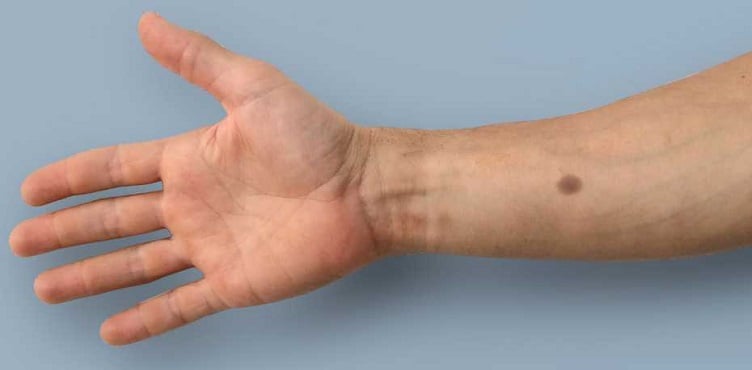 As calcium levels exceed a particular threshold, an implant inserted under the skin triggers melanin production and causes a mole to form. Source: ETH Zurich
Cancer has emerged as a major cause of death in industrialized countries and many of the people affected are diagnosed only after the tumor has developed extensively. The ability to detect such tumors reliably and early would not only save lives, but also reduce the need for expensive, stressful treatment.
An early warning system has been developed for the four most common types of cancer: prostate, lung, colon and breast cancer. When the level of calcium in blood increases due to a developing tumor, the synthetic gene network devised at ETH Zurich in Switzerland is triggered.
The genetic network is integrated into human body cells, which in turn are inserted into an implant. This encapsulated gene network is then implanted under the skin where it constantly monitors the blood calcium level.
As soon as the calcium level exceeds a particular threshold value over a longer period of time, a signal cascade is triggered that initiates production of the body’s tanning pigment melanin in the genetically modified cells. The skin then forms a brown mole, long before cancer is detectable through conventional diagnostics, that is visible to the naked eye.
According to the researchers, the implant is intended primarily for self-monitoring, making it very cost effective. For those who would prefer not to deal with the constant stress, an implant can also be used that develops a mark visible only under a red light.
A drawback is that the implant’s service life is limited; past research has shown that encapsulated living cells last for about a year and must be inactivated and replaced after that.
The prototype functioned reliably when tested in a mouse model and on pigskin. Moles developed only when the calcium concentration reached a high level.
Clinical trials have yet to be conducted, so the researchers estimate that bringing the cancer diagnosis implant to market maturity will require at least 10 years of R&D.
The research is published in Science Translational Medicine.