Physicists Design Model of Winter on Mars Based on Ice Particles
Siobhan Treacy | April 05, 2018MIPT researchers and colleagues have developed a numerical model of Mars’ water cycle and winter. Past studies on Martian climate have focused on airborne dust particles that were water condensation nuclei on Mars. The new study focused on smaller particles that have been harder to study in the past. This has led to results that are the most accurate and consistent to date.
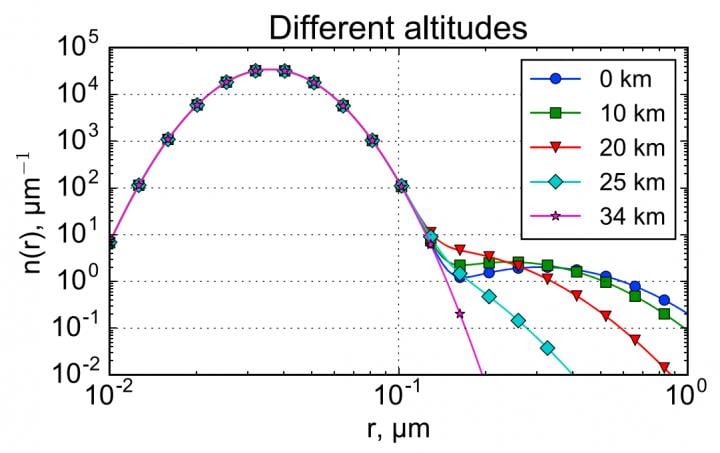 Bimodal size distribution of particles. Source: Dmitry Shaposhnikov et al./Journal of Geophysical Research: Planets
Alexander Rodin, head of the Laboratory of Applied Infrared Spectroscopy at MIPT, said, "Our model describes the 3-D motions of the air masses on Mars, solar and infrared radiation transfer, phase transitions of water, and the microphysics of Martian clouds, which is pivotal to the planet's hydrological circulation."
Mars doesn’t have much water, especially in the cold atmosphere. There is some water present on Mars, but there is so little of it that it has a major impact on the climate of Mars. When looking at the water processes that happen on Mars researchers needed to look at how water vapor and ice particles are transported and then redistributed through the planet.
The past calculations haven’t always matched what was observed on Mars’ atmosphere. Numerical models are based on the idea of water condensing on aerosols that are suspended in the atmosphere. Modeling the results depends on aerosol particle distribution, which has been unclear for years. But, recent observations have proven that there are two peaks in aerosol distribution during Mars’ seasons, called bimodal distribution.
During the study, the team created a model of Mars’ hydrological cycle based on the bimodal aerosol distribution. A 3D general circulation model of the atmosphere called Martian Atmosphere Observation and Modeling (MAOAM) was created at Max Planck Institute. This helped the team build a theoretical model that helped the team figure out what the phase transitions of water are on Mars.
The team found that water concentration reaches its all-time high in Mars’ North Pole in the Northern Hemisphere during Mars’ summer. As winter starts, the density of the airborne vapor decreases. Researchers believe that the water could condense and fall on the surface as some kind of precipitation. The team’s calculations were identical to the SPICAM map.
The method was also used to calculate density and atmospheric distribution of clouds that were formed by ice crystals. A major part of ice was located at the equator at the same time as when the water vapor density reached the maximum at the North Pole during northern summer.
The team says that these results were gathered with a bimodal approach that is different from the calculations that were gathered with the idea that there is only one peak.
The paper on this research was published in Journal of Geophysical Research: Planets.