Using Tech to Limit Car Pollution to Study Exoplanetary Atmospheres
Peter Brown | April 04, 2018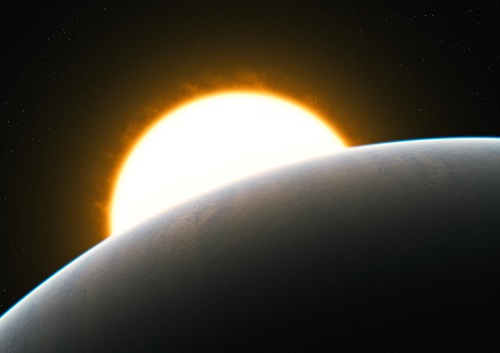 An artist rendering of a large planet near its star. Source: Laboratoire Interuniversitaire des Systèmes AtmosphériquesChemical models that were developed in order to help to limit car engine emissions are now being used to study the atmospheres of hot exoplanets that are orbiting close to their stars.
Large planets that are similar in size to Jupiter or Neptune but orbit their sun 50 times closer than the Earth does are thought to be composed of hydrogen-rich gas at temperatures between 1,000 and 3,000 degrees Celsius while circulating at speeds of nearly 10,000 kilometers per hour. The combination of these extreme conditions can drive the atmospheres of these hot exoplanets out of chemical equilibrium. This results in deviations that are hard to explain through standard astrophysical models and observations.
"The philosophy of our team in solving problems is to search for and import well-tried methods from any other field whenever they exist,” says Oliva Venot, a researcher at Laboratoire Interuniversitaire des Systèmes Atmosphériques (LISA) in France involved in the research. “Back in 2012, we first noticed the overlap of temperature and pressure conditions between the atmospheres of hot Jupiters and car engines.”
Venot says the chemical networks developed for car engines are robust after years of R&D, studies and validation. These car models are valid for temperatures up to more than 2,000 degrees Celsius and a wide range of pressures making them relevant for the study of a large diversity of warm and hot exoplanet atmospheres.
The models of the chemical composition of hot Jupiter and warm Neptune are based on one or several networks of chemical reactions. These chemical networks are available in an open access database and are widely used and recognized in the international astrophysics community.