Strides in Regenerative Medicine: Bone Engineering
Tony Pallone | March 08, 2018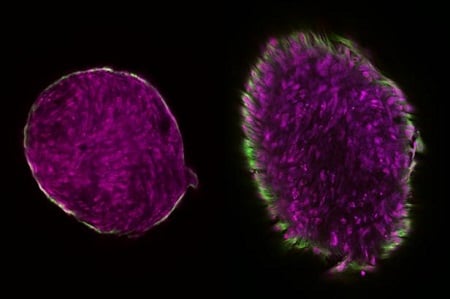 Cartilage template formation via engineered extracelluar matrix. Source: Syam Nukavarapu/UConn Photo
There are over 200 bones in an adult human skeleton, and they measure anywhere from a couple millimeters to well over a foot. These bones vary in terms of how they form and how they are repaired after an injury — and this has presented challenges for researchers in the field of regenerative medicine.
But a team of UConn Health researchers has designed a novel system to help address some of those challenges. The system, which employs hybrid hydrogels, takes its cues from the process the body uses to form long bones such as a femur and humerus.
That process, called endochondral ossification (EO), differs from intramembranous ossification (IO), which the body uses to form flat bones. The IO process is significantly easier to recreate in the lab, as it relies simply on stem cells specializing into bone-forming cells. That relative simplicity comes with limitations, however, as the IO-formed bone lacks blood vessels (also known as vascularization); as a result, it is not capable of regenerating enough bone tissue to be applied to large bone defects resulting from trauma or degenerative disease.
By contrast, vascularization is a natural outcome of EO, which involves additional steps such as the development of a cartilage template. By developing a hybrid hydrogel combination for their system, the researchers were able to form an engineered extracellular matrix, or scaffold, to support cartilage-template formation.
Yet their method is far from simple. EO requires precise spatial and temporal coordination of a variety of elements, and the researchers are pioneering new territory with their approach.
"Thus far, very few studies have been focused on matrix designs for endochondral ossification to regenerate and repair long bone," says research team leader Syam Nukavarapu, an associate professor of orthopedic surgery who holds joint appointments in the departments of biomedical engineering and materials science and engineering.
Next, the team plans to integrate a load-bearing scaffold into the extracellular matrix. According to Nukavarapu, this could be the first step toward forming a cartilage template with all the right ingredients to initiate bone tissue formation, vascularization, remodeling and ultimately the establishment of functional bone marrow to repair long bone defects.
The research is the featured cover story on a recent issue of the Journal of Biomedical Materials Research.