Regenerating Bones, Tissues with Apple Waste
S. Himmelstein | March 30, 2017An apple a day may not really keep the doctor away, but apple waste can help regenerate bone and cartilage tissues. Spanish researchers developed a matrix from apple waste, or pomace, to promote cell growth.
These biocompatible materials can be useful in regenerative medicine for diseases such as osteoporosis, arthritis, or osteoarthritis. Transformation of apple pomace into value-added commodities is also of environmental interest, as this would reduce the volumen of waste requiring treatment.
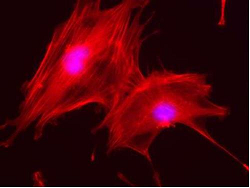 Osteoblast cells of a mouse growing on 3-D matrices and developed from agri-food industry waste. Source: Milagros Ramos, Ángeles Martín, Malcolm Yates and Violeta Zurdo (CTB-UPM y CSIC)
Sequential extractions of bioactive molecules, such as antioxidants or pectin, enabled the researchers to obtain the material from which a matrix with suitable porosity and texture can be developed for use in tissue engineering.
The primary extraction of antioxidants and carbohydrates constitutes 2% of the dry weight of apple pomace; pectin extraction accounts for 10%. The extracted chemical cells have recognized value as nutraceuticals and pectin is a material of great utility in medical applications, such as in antitumor drugs or in the treatment of coetaneous wounds.
The materials remaining after antioxidant and pectin removal can still confer adequate structure, texture, and composition to grow diverse types of cells. In this particular case, the chosen cells were osteoblasts and chondrocytes, both of which are useful for the regeneration of bone and cartilage tissues.
The researchers are now developing new applications that allow them to structure customized biomaterials through 3-D printing techniques. Scientists from the Centre for Biomedical Technology at Universidad Politécnica de Madrid, in collaboration with Instituto de Ciencia de Materiales and Institute of Catalysis and Petrochemistry from Spanish Council for Scientific Research participated in this research.