
Watch Graphene Take a Ride in the ‘Vomit Comet’
S. Himmelstein | February 02, 2018Graphene has found use in an incredible array of applications, from water sensors to health monitors, energy harvesters, photonics….One could say the 2D wonder material is really taking off.
And indeed it has: graphene samples took a ride in a ‘vomit comet’ — an aircraft undergoing Zero-G parabolic flight — so that researchers could weigh the material’s utility in cooling systems for satellites.
Microgravity experiments designed by a Graphene Flagship, European Space Agency and the University of 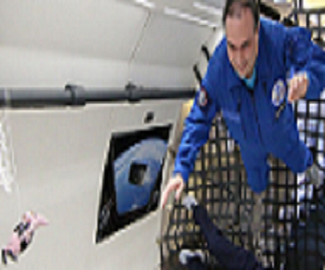 Researchers experienced weightlessness to test graphene’s application in space. Source: University of CambridgeCambridge Graphene Centre collaboration sought to improve the performance of cooling systems in use in satellites by exploiting graphene’s excellent thermal properties. The material is being tested in loop-heat pipes, pumps that move fluid without the need for any mechanical parts. The addition of graphene is expected to result in a loop heat pipe that can operate reliably and autonomously in space.
In these cooling schemes, evaporation and condensation of a fluid transport heat from hot electronic systems out into space. The pressure of the evaporation-condensation cycle forces fluid through the closed systems, providing continuous cooling.
The metallic wick, where fluid is evaporated into gas, was coated in graphene to enhance heat pipe efficiency two-fold. Its thermal properties improve heat transfer from the hot systems into the wick. The porous structure of the graphene coating increases the interaction of the wick with the fluid, and improves the capillary pressure so that liquid can flow through the wick faster.
In accord with laboratory results, the graphene-coated wicks demonstrated excellent performance, with more efficient heat and fluid transfer compared to untreated wicks during the flight. The researchers are continuing to optimize the coatings for applications in real space conditions.
"... The material is being tested in loop-heat pipes, pumps that move fluid without the need for any mechanical parts. ..."
Wow! This is a breakthrough! No mechanical parts?!?
Absolutely incredible. Unbelievable, literally!
What kind of parts does it use? Virtual? Imaginary? Hypothetical? Probably enigmatic. Yeah, it has to be enigmatic. Let's go with that until further notice.
.
Oh wait. I get it. I bet it only pumps
enigmatic fluid as well.