High Temperatures Can Create Graphene from Ethene
Siobhan Treacy | May 04, 2017Scientists from all over the world have teamed up to create a new way to produce single-layer graphene from ethene, otherwise known as ethylene — the smallest alkene molecule.
Researchers produced graphene on a rhodium catalyst substrate by heating ethene in stages to slightly over 700 degrees Celsius. This is hotter than any other experiment attempted before, and was why it was so successful.
This new technique has a lower cost and is much simpler to operate than past experiments. It opens new doors for creating graphene. Graphene has many attractive physical and electronic properties. This research gives a new development for the self-evolution of carbon cluster precursors, which results in the new formation of graphene layers.
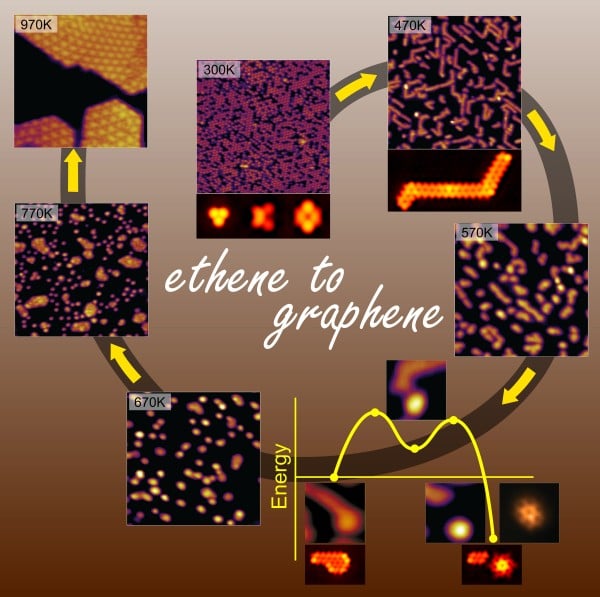 Measured and theoretically simulated images of stages in the dehydrogenation process observed in programmed surface heating experiments. The sequence starts from adsorbed ethene (at 300K), leading to self-evolved 24-carbon-atom cluster precursors (between 570K and 670 K), and culminates with graphene formed at elevated temperatures. Source: U. Landman and B. Yoon
“Since graphene is made from carbon, we decided to start with the simplest type of carbon molecules and see if we could assemble them into graphene,” explained Uzi Landman, a Regents’ Professor and F.E. Callaway endowed chair in the Georgia Tech School of Physics, who headed the theoretical component of the research. “From small molecules containing carbon, you end up with macroscopic pieces of graphene.”
Graphene is currently being produced using many methods. These methods include chemical vapor deposition, evaporation of silicon from silicon carbide and exfoliation of graphene sheets from graphite. There have been past efforts to create graphene from simply hydrocarbon precursors, but they were unsuccessful.
Researchers have discovered that the path from ethene to graphene has involved a formation of a series of structures when hydrogen atoms leave the ethene molecules and carbon atoms self-assemble into graphene. Experimental groups in Germany and Scotland researched the nature of thermally-induced rhodium surface-catalyzed transformations and they raised the temperature step by step in a ultra-high vacuum. They used scanning-tunneling microscopy (STM), thermal programmed desorption (TPD) and high-resolution electron energy loss spectroscopy (HREELS) in each step of the process.
When heated, ethene absorbed into the rhodium catalyst evolves by coupling reactions, which formed segmented one-dimensional polyaromatic hydrocarbons (1D-PAH). When heated, dimensionality crossover happens — when one-dimensional structures change into two-dimensional structures — and restructuring at the PAH chain ends with an activated detachment of size-selective carbon clusters. A mechanism is revealed through first principles quantum mechanical simulations. Lastly, rate limiting diffusional coalescence of these cluster-precursors leads to condensation into high purity graphene.
At the final stage, researchers observed disk-like clusters with 24 carbon atoms spread out to form the graphene lattice. “The temperature must be raised within windows of temperature ranges to allow the requisite structures to form before the next stage of heating,” Landman explained. “If you stop at certain temperatures, you are likely to end up with coking.”
The dehydrogenation process is an important step in this process. This frees carbon atoms and forms intermediate shapes, but some of the hydrogen stays temporarily near the metal catalyst surface. These atoms assist in the bond-breaking process which detaches the 24 carbon cluster.
The final graphene structure is absorbed onto the catalyst. This could be useful when attached to metal, but if it is to be used for anything else they must be removed. A removal process is currently being developed.
This work was published in The Journal of Physical Chemistry.