NASA’s InSight Lander Will Study the Martian Deep Interior in 2018
Eric Olson | January 26, 2018In the spring of 2018, NASA plans to send a mission to Mars to study its deep interior, shedding light on the origins of the red planet as well as other rocky planets. The Interior Exploration using Seismic Investigations, Geodesy and Heat Transfer (InSight) mission will set a lander down on a smooth, flat plain on the Martian surface called Elysium Planitia to carry out two years of geophysical investigations.
Interior Exploration
 Engineers at Lockheed Martin Space Systems in Denver, CO guide the parachute cone for NASA’s InSight spacecraft during its installation. Source: NASA/JPL-Caltech/Lockheed Martin
The lander will perform several studies that will reveal information about the interior structure and activity of Mars and the processes that formed and shaped the planet. This will help scientists understand how the inner solar system’s terrestrial planets, including Earth, formed and evolved.
"Because the interior of Mars has churned much less than Earth's in the past three billion years, Mars likely preserves evidence about rocky planets' infancy better than our home planet does," said InSight Principal Investigator Bruce Banerdt of NASA's Jet Propulsion Laboratory in a news release.
The mission will determine the size and composition of the planet’s core and whether it is liquid or solid. It will also establish the thickness and structure of the crust, the composition and structure of the mantle and the thermal state of the planet’s interior. In addition, InSight will quantify the amount of tectonic activity on Mars as well as the rate of meteorite impacts.
InSight will join a growing collection of robotic explorers investigating the red planet. Three NASA orbiters are already orbiting Mars, including Mars Odyssey, Mars Reconnaissance Orbiter and MAVEN. They are joined by two operational rovers on the surface, Opportunity and Curiosity, with one due to launch in 2020. These robotic missions are paving the way for planned human missions to Mars in the 2030s.
InSight’s science payload is focused on characterizing the geophysical properties of the red planet and includes two instruments and a third experiment. The equipment will measure the planet’s internal activity, temperature and orbital oscillations caused by its moons and the Sun.
Seismic Waves
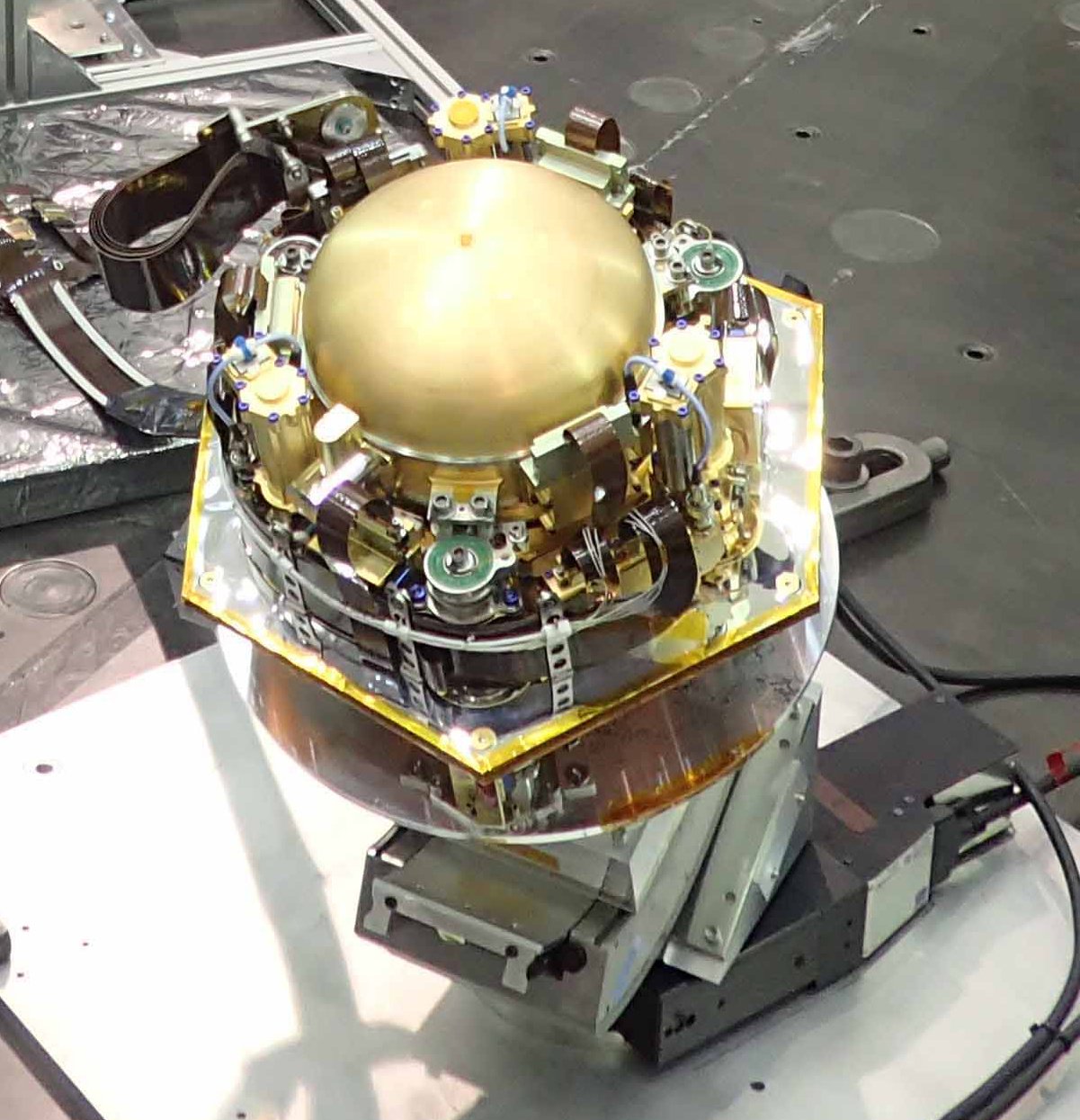 The Seismic Experiment for Interior Structure (SEIS) instrument is set up for a checkout in a Lockheed Martin clean room facility in Littleton, Colorado. Source: NASA/JPL-Caltech/Lockheed Martin
The lander’s first instrument is the Seismic Experiment for Interior Structure (SEIS), a seismometer that will record seismic waves from “marsquakes” and meteor impacts. This finely tuned device will provide information on the structure and materials of the Martian interior. With a sensitivity and frequency response that matches the most advanced seismometers on Earth, it will be able to detect ground motions as small as half the diameter of a hydrogen atom. To protect this delicate instrument from the Martian wind and thermal extremes, it will be covered by a shield.
The SEIS instrument has been a source of problems for the mission. Its original metal container had a leak and failed to maintain the required near-vacuum conditions around the instrument’s main sensors. The issue forced a delay of the mission from its original March 2016 launch date, although the container has been redesigned and rebuilt and now functions as expected.
The SEIS is provided by the French Space Agency (CNES) with participation by the Institut de Physique du Globe de Paris (IPGP), the Swiss Federal Institute of Technology (ETH), the Max-Planck-Institute for Solar System Research (MPS), Imperial College and the Jet Propulsion Laboratory (JPL).
Interior Heat
InSight’s second instrument will measure the amount of energy coming from the planet’s interior to shed light on Mars’ thermal history. Provided by the German Space Agency (DLR), the Heat Flow and Physical Properties Probe (HP3) will tunnel to a greater depth than any other Martian probe. The instrument will penetrate five meters into the planet’s crust with a hammering action, leaving behind a tether with temperature sensors every 10 cm (3.9 in.) along its length to precisely measure the temperature profile of the subsurface.
Core Size
Finally, InSight’s Rotation and Interior Structure Experiment (RISE), led by JPL, uses the lander’s X-band radio to measure wobbles in Mars’ rotation. It accomplishes this by gauging the Doppler shift and ranging of radio transmissions between Earth and the lander. These measurements can be used to calculate the size of the planet’s core since the size and state of the core affect the planet’s moment of inertia and damping, leading to fluctuations in its rotation.
The lander will also have a robotic arm for deploying the SEIS and HP3 instruments as well as cameras that will help guide the deployment of the instruments to the ground. The science payload will be mounted on a lander structure adapted from NASA’s Mars Phoenix mission and built by Lockheed Martin Space Systems.
Along with science equipment, the lander will be carrying two microchips etched with the names of over 2.4 million space enthusiasts. In a bid to generate interest in the mission, NASA invited members of the public to submit their names to be transported to the red planet on these chips.
The mission’s launch window opens on May 5, 2018, with a landing scheduled for November 26, 2018. Surface operations are scheduled to last 728 Earth days (708 Martian sols).
Instrumentation
 Source: NASA/JPL-Caltech
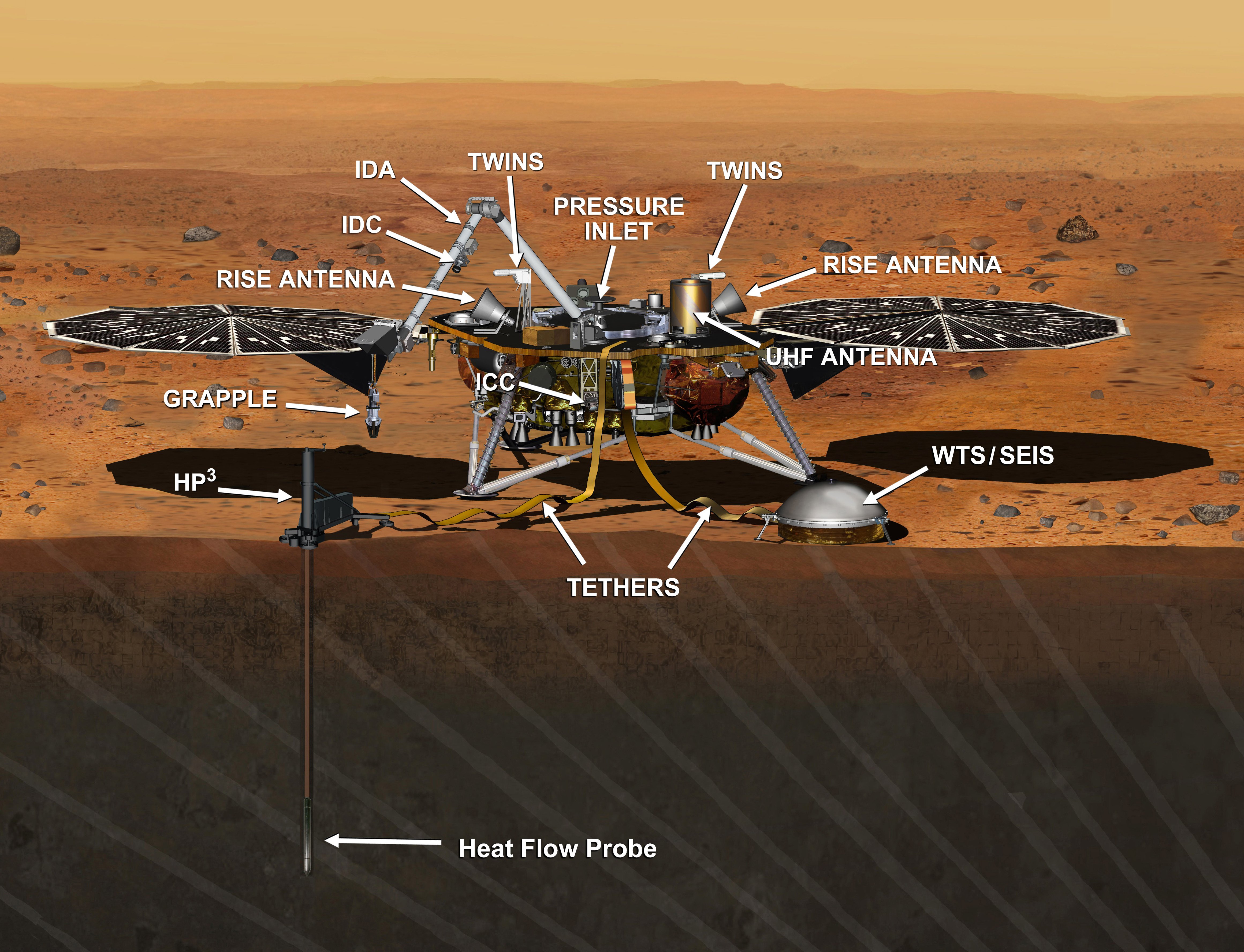
The following components are shown in the annotated image above:
- Grapple: Mechanism at the end of the IDA that grips the instruments during deployment
- Heat flow probe: Hammering mechanism that pulls the temperature sensors down into the regolith
- HP3: Heat Flow and Physical Properties Package, the heat flow experiment
- IDC: Instrument deployment camera, pointable medium-resolution camera
- IDA: Instrument deployment arm
- ICC: Instrument context camera, a fixed wide-angle camera
- Pressure inlet: Wind-shielded opening for pressure sensor
- RISE antenna: X-band radio antenna for the Rotation and Interior Structure Experiment
- SEIS: Seismic Experiment for Interior Structure, the seismometer
- Tethers: Cables carrying electrical power, commands and data between the lander and instruments
- TWINS: Temperature and Winds for InSight, environmental sensors
- UHF antenna: Antenna used for communication with orbital relay spacecraft
- WTS: Wind and thermal shield protecting the seismometer from the environment