Efficient Hydrogen Production with Black Phosphorus Photocatalyst
S. Himmelstein | January 24, 2018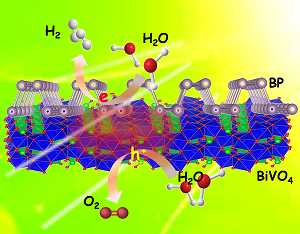 Photocatalytic water splitting using the 2D heterostructures of black phosphorus/bismuth vanadate without any sacrificial agents under visible light irradiation. Source: Osaka University
Production of clean-burning hydrogen requires use of catalysts to split water, which in turn depends on external energy inputs from chemicals or electric power sources. An energy-efficient photocatalytic scheme developed at Osaka University for hydrogen generation exploits a wide range of the solar spectrum.
The system combines nanostructured black phosphorus for water reduction to hydrogen and bismuth vanadate for water oxidation to oxygen. The flat, 2D structure of black phosphorus, similar to that of graphene, strongly absorbs light across the visible spectrum. The two components of this new catalyst rapidly transfer electrons excited by sunlight.
The optimum hydrogen and oxygen production rates on black phosphorus/bismuth vanadate were approximately 160 and 102 μmol g−1 h−1 under irradiation of light with a wavelength longer than 420 nm, without using any sacrificial agents or external bias.