Predicting How Semiconductors Weather Abuse
John Simpson | August 03, 2016One of the challenges for scientists working to create systems that efficiently convert sunlight, water, and carbon dioxide into fuel is finding materials that can do the work while surviving the corrosive conditions that are part of the process.
While existing methods to determine material stability have been hit or miss, a research team from the Department of Energy’s Lawrence Berkeley National Laboratory (Berkeley Lab) has applied a combination of experimental and theoretical tools to rigorously determine how well a material will weather the harsh environments present in these systems.
“We need to develop a set of techniques that could give us a more accurate assessment of how a material will behave in real-world applications," says Francesca Toma, a scientist in Berkeley Lab's Chemical Sciences Division. "Having methods that allow us to understand how a material degrades and to predict its stability over the years is an important advance.”
A key step in both natural and artificial photosynthesis is the splitting of water into its constituents, hydrogen and oxygen. In natural systems, stability of the components that perform this function is not required, since they can self-heal in living cells.
But unlike plants, practical solar fuel generators demand stable materials that do not need to be continuously replenished. Another consideration is that these devices need to operate in highly corrosive conditions that exacerbate the wear and tear on sensitive components. Unfortunately, most materials do not survive in these environments, and their performance degrades accordingly, the researchers say.
The scientists focused on bismuth vanadate, a thin-film semiconductor that has emerged as a leading candidate for use as a photoanode—the positively charged part of a photoelectric cell that can absorb sunlight to split water. Going by traditional approaches to predict material characteristics, bismuth vanadate should be resistant to chemical attack. It is not.
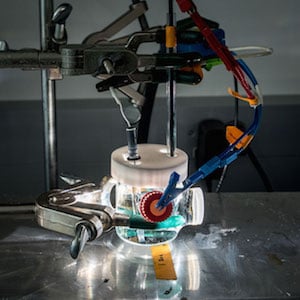 A bismuth vanadate thin-film electrode is tested in an electrolyte solution to mimic conditions in an artificial photosynthesis device. Image credit: Paul Mueller/Berkeley Lab. In reality, bismuth vanadate exhibits complex chemical instabilities that originate from kinetic limitations that are related to the inability to structurally reorganize the surface phase such that it could reach a stable configuration under the operating conditions.
The scientists used carefully selected experimental methods to analyze bismuth vanadate before and after its use, as well as directly under operational conditions. They found an accumulation of light-generated charge at the surface of the film, which led to structural destabilization and chemical attack of the metal oxide semiconductor.
“Today, bismuth vanadate is one of the best materials available for constructing photoanodes,” says Berkeley Lab scientist Jeff Sharp. “Ultimately, though, we need to discover new semiconductors that can more efficiently absorb light and help drive the reactions that allow us to store energy from the sun in chemical bonds.”
One of the next steps in understanding these materials is to study the relation between the local chemical composition and performance over different length and time scales under operating conditions.