Entrepreneur Corner: A Portable Device to Generate Corrective Lens Prescriptions in the Developing World
Electronics360 News Desk | January 17, 2018MIT’s spinoff company PlenOptika introduced a portable autorefractor that measures refractive errors of the eye and produces estimated prescriptions in 10 seconds. After six years of development and countless clinical studies in many countries, the device — called QuickSee — has hit the Indian market.
In poor countries and rural areas in particular, getting eyeglasses prescriptions is very difficult. Normally optometrists only serve urban areas, leaving many people with permanent impairments that, according to the World Health Organization (WHO), lead to low quality of life, learning difficulties and lost employment opportunities.
“People at the bottom of the pyramid have poor vision, because they don’t have glasses or aren’t aware of how to get glasses. It’s a big unmet medical need we’re trying to address,” says Shivang Dave, one of four former postdocs at the Madrid-MIT M+Visión Consortium (now MIT LinQ), along with Daryl Lim, Eduardo Lage and Nicholas Durr.
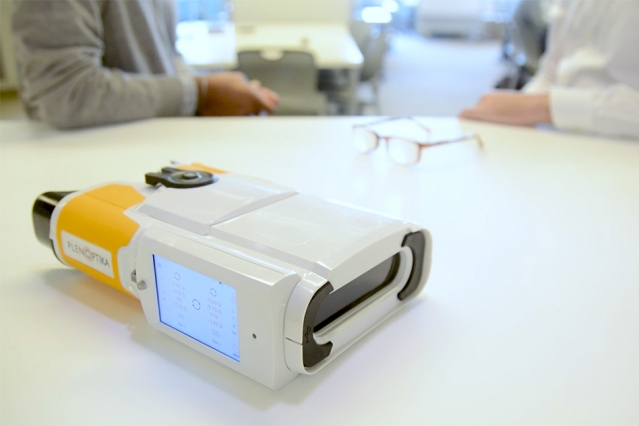 MIT spinout PlenOptika’s portable autorefractor called QuickSee that measures refractive errors of the eye. Source: PlenOptika
Autorefractors work by detecting reflections from infrared light shone into the eye to the retina. The reflected light is used to determine the size and shape of a ring at the back of the eye in order to formulate corrective lens prescriptions. Existing autorefractors are large, heavy, stationary machines that cost up to $15,000.
QuickSee is a small, portable model that has the shape of binoculars, so it can measure both eyes at the same time, and its price is about one-third of a standard model. A technician taps a green arrow on a digital screen on the device to start the measurement. In about 10 seconds, the device displays a prescription estimate on the digital screen.
In 2011, the PlenOptika co-founders were the first cohort of fellows in the Madrid-MIT M+ Visión Consortium under the direction of Martha Gray, the J. W. Kieckhefer Professor of Health Sciences and Technology and a professor of electrical engineering and computer science. They chose to design a product that could realistically solve a large-scale global problem.
“It was an accelerated way to achieve impact, as opposed to doing some basic research and waiting years down the line to have impact,” Dave says. “In developing countries, they soon learned, vision correction isn’t just a money issue: Often, people can afford glasses, but there aren’t enough optometrists and portable diagnostic equipment to reach rural areas. We couldn’t train 100,000 new optometrists, but we could look at the technologies available and re-engineer them to be lower cost and easier to use."
MIT’s entrepreneurial ecosystem was key in helping launch the startup six years ago. In 2012, the PlenOptika team won the MIT $100K Entrepreneurship Competition, and MIT’s Venture Mentoring Service (VMS) offered invaluable advice on founding a company and fundraising, as well as connecting with potential partners.
“They’ve mentored us on everything,” Dave says. “I can’t say enough good things about the VMS.”