Bell’s Next Generation Tiltrotor Aircraft Makes First Flight
Eric Olson | December 21, 2017Bell Helicopter’s V-280 Valor prototype tiltrotor aircraft lifted off in its first flight on December 18 at a company facility in Amarillo, Texas. In a video released by Bell, the rotorcraft rose to a height of about 20 feet and hovered for about 20 seconds.
Tiltrotor designs provide a vertical lift capability equivalent to a helicopter combined with the horizontal flight of traditional propeller-driven aircraft.
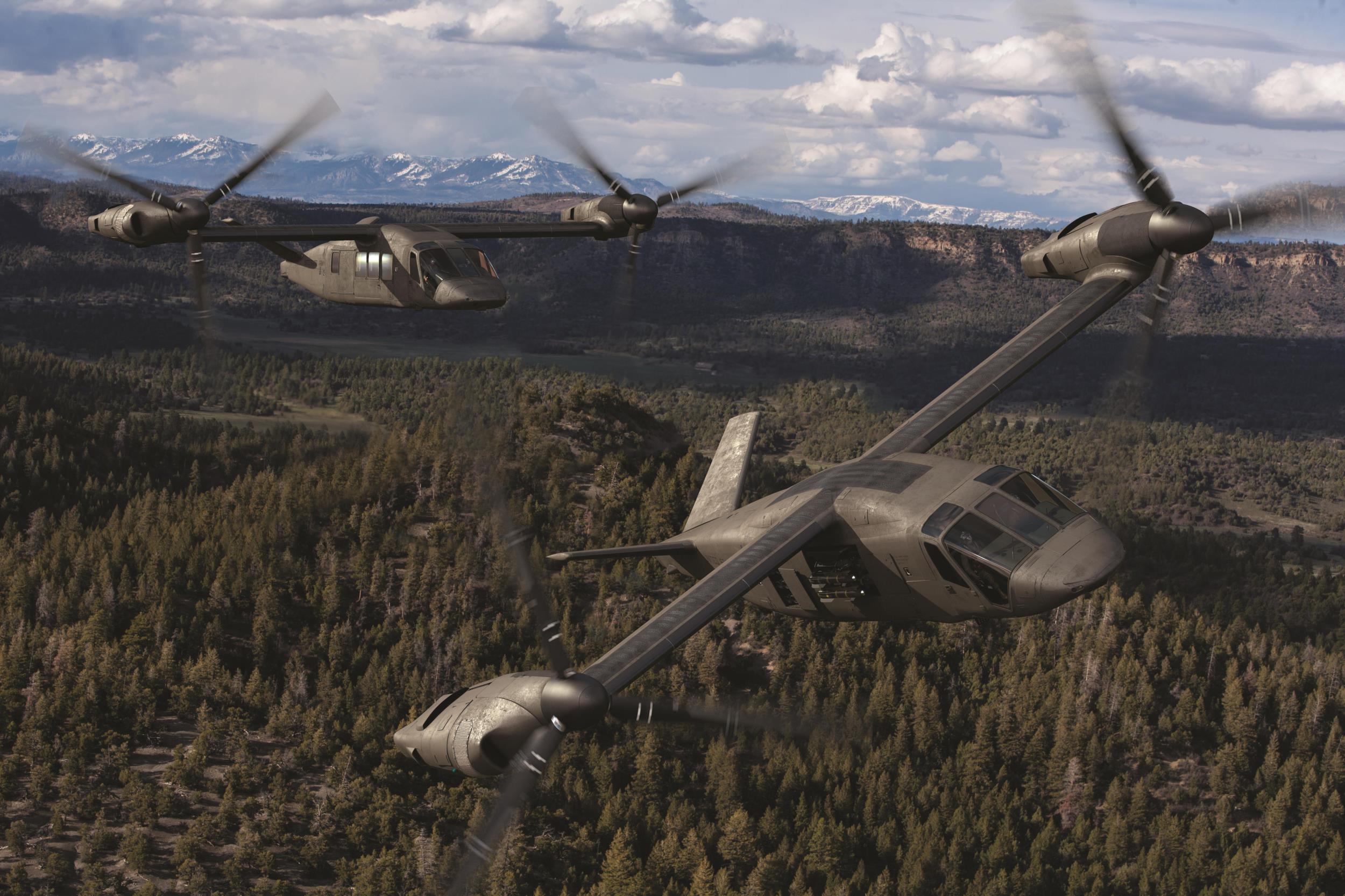 Artist's concept of two V-280s flying in formation. Credit: Bell Helicopter
“This is an exciting time for Bell Helicopter, and I could not be more proud of the progress we have made with the first flight of the Bell V-280,” said Mitch Snyder, Bell Helicopter’s president & CEO. “First flight demonstrates our commitment to supporting Department of Defense leadership’s modernization priorities and acquisition reform initiatives. The Valor is designed to revolutionize vertical lift for the U.S. Army and represents a transformational aircraft for all the challenging missions our armed forces are asked to undertake.”
Bell is developing the V-280 Valor for the U.S. Army’s Joint Multi-Role Technology Demonstrator (JMR-TD) initiative. JMR-TD is intended to mature and validate advanced airframe and propulsion technologies leading up to the Future Vertical Lift (FVL) program. FVL is the Pentagon’s long-strategy to replace all of its helicopters with more capable successors.
“We are thrilled to share in this success of the V-280 first flight with Team Valor,” said Snyder. “The V-280 intends to completely transform what is possible for the military when it comes to battle planning and forward operations.”
With a useful load of more than 12,000 lbs, the third generation tiltrotor will have a crew of 4 (including two pilots) and be capable of transporting up to 14 troops. Cruising at a speed of 280 knots, it can reach a top speed of 300 knots. The V-280 can strategically self-deploy (without refueling) to a range of over 2,100 nautical miles and has an effective combat range of 500 to 800 nm. Its hot and high hover performance is 6,000 feet and 95°F.
The V-280’s airframe is strongly reminiscent of the V-22 Osprey tiltrotor in service with the Marine Corps and Air Force. Unlike the V-22, however, the V-280’s engines do not rotate with the rotors. They remain fixed underneath nacelles attached to the wings, transferring power through a tilting gearbox to the rotors. “The output shaft is connected to the drive system through a spiral bevel gearbox that transfers power to the fixed gearbox and proprotor gearbox, which rotates on two big spherical bearings driven by a conversion actuator mechanism,” according to Bell. The design is substantially simplified from the V-22’s tiltrotor solution.
“Team Valor” is comprised of a number of suppliers. Prime contractor Bell Helicopter is joined by Lockheed Martin (cockpit, avionics, distributed aperture system, mission equipment package), Moog (flight control computer and actuators), General Electric (two T64 turboshaft engines), GKN Aerospace (V-tails and control surfaces), Spirit AeroSystems (fuselage), Eaton (hydraulic system), Meggitt (fuel system), Astronics (electrical system), TRU (simulation and training), Lord (elastomerics), and Israel Aerospace Industries (nacelle structures and aircraft seats).
A competitor to the V-280 in the FVL program is being developed by partners Sikorsky and Boeing. The SB>1 Defiant has contra-rotating main propellers along with a pusher prop at its rear.
The FVL program seeks to replace all military helicopters, from scout craft serving in armed reconnaissance roles to ultra large vehicles with performance equivalent to traditional turboprop military transports with the addition of a vertical lift capability. The program splits these operational capabilities into five different categories of aircraft design.
The V-280 and SB>1 will compete in the FVL-Medium class, or Capability Set 3, which will culminate in a successor to replace the Sikorsky UH-60 Black Hawk and Boeing AH-64 Apache helicopters.