Bat Wings May Help Identify Individual Bats
Marie Donlon | October 25, 2017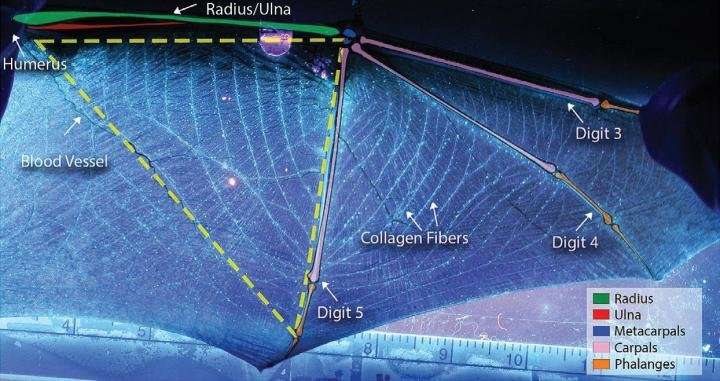 Photograph of a bat's left wing illustrates wing structure and shows the collagen fibers that Forest Service scientist Sybill Amelon and her colleagues believe may be the key to identifying individual bats. Source: Journal of Mammalogy (2017). DOI: 10.1093/jmammal/gyx018Like human fingerprints, bat wings can be used to reliably identify individual bats, according to a research team from the USDA Forest Service.
Publishing their findings in the Journal of Mammalogy, researchers determined that the patterns of small lines (called collagen-elastin bundles) visible in bat wings could be used to identify bats for the purpose of wildlife research.
A current method for identifying individual bats, according to the research team, includes adding markers, which can harm the creatures and affect their behavior.
"It is always important to use research techniques that do not diminish the health or survival of the animals we study, but white-nose syndrome has made this even more critical in bat research," said Forest Service scientist Sybill Amelon.
Looking at photographs of bat wings, the research team was able to identify individual bats with a 96 percent success rate based entirely on the crisscross pattern of the collagen elastin bundles even when wing tissue — the primary target of the fungus from white-nose syndrome — was damaged.
"Bats are a major predator of forest and agricultural insects and are important to forest health," said Tony Ferguson, director of the northern research station and the forest products laboratory. "This research is one of the ways that the Forest Service is advancing knowledge of an elusive species and contributing to the national effort to control white-nose syndrome."
To read more, go to the Journal of Mammalogy.