NASA Tests 3D-printed Bimetallic Alloy Igniter
S. Himmelstein | September 25, 2017Engineers at NASA's Marshall Space Flight Center in Huntsville, Ala., report an advance in rocket science: the 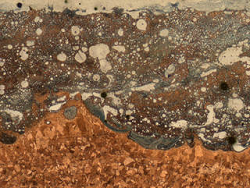 Image from a microscope reveals how the copper alloy and Inconel interlock to form a strong bond. Source: NASA/UAH/Judy Schneideragency’s first 3D-printed rocket engine igniter prototype composed of two different metal alloys has been tested. Additive manufacturing with more than one metal is expected to reduce future rocket engine costs by up to a third and manufacturing time by 50 percent.
The prototype, fabricated by DMG MORI in Hoffman Estates, Ill., was low-pressure hot-fire tested more than 30 times. Subsequent analysis of images of the bimetallic interface through a microscope revealed that the two metals had inter-diffused to form a strong bond.
The 3D printing approach can save considerable time, costs and labor relative to the traditional brazing process for manufacturing igniters. Automated blown powder laser deposition, a hybrid 3D printing system, was used to join a copper alloy and Inconel together. The prototype formed a single part instead of the four that are commonly brazed and welded together. The additive manufacturing equipment combines 3D printing and computer numerical-control machining technologies.
“We’re encouraged about what this new advanced manufacturing technology could do for the Space Launch System program in the future,” said Steve Wofford, manager for the SLS liquid engines office at Marshall. “In next generation rocket engines, we aspire to create larger, more complex flight components through 3-D printing techniques.”