Rocket Engine Nozzles Produced with New 3D Printing Technology Hot-fire Tested
Eric Olson | March 23, 2018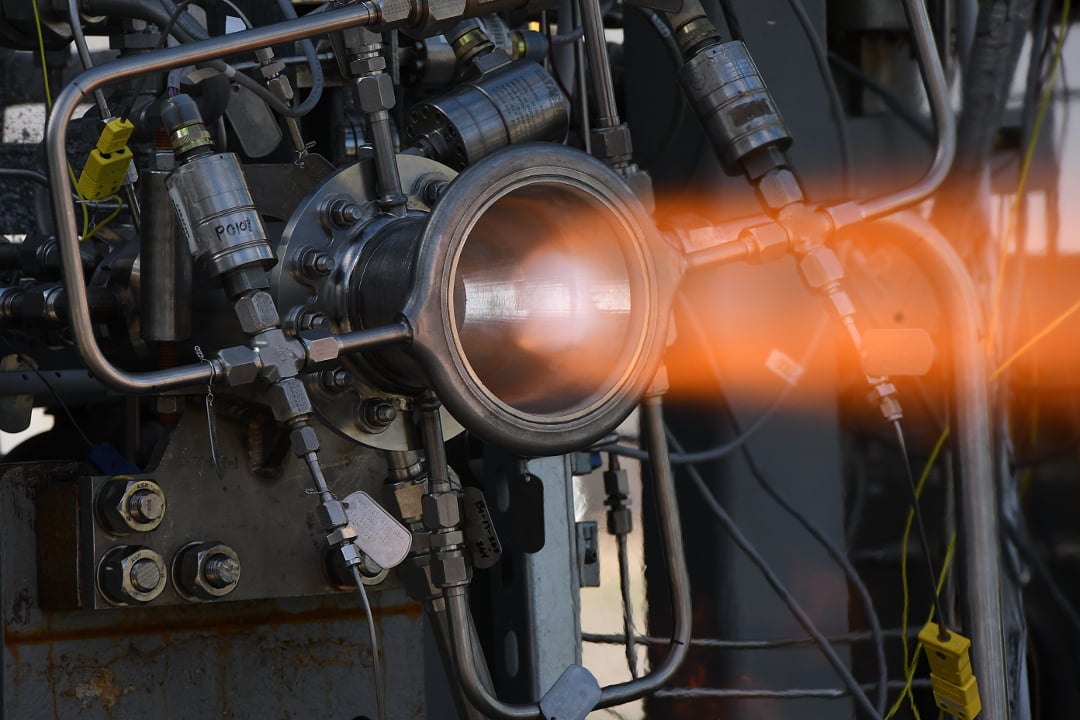 A rocket engine nozzle with water jet-milled coolant channels sealed by a new additive manufacturing process is hot-fire tested at NASA's Marshall Space Flight Center. Source: NASA/MSFC/David OliveTo stand up to the extreme temperatures and pressures from the combustion process, rocket engine nozzles require careful engineering and expensive fabrication processes. To reduce manufacturing costs and development time, a team of engineers at NASA's Marshall Space Flight Center in Huntsville, Alabama, has developed a new 3D printing method for nozzle fabrication.
The new technique is called Laser Wire Direct Closeout (LWDC) and manufactures material in place with a freeform-directed energy wire deposition process. The new technology has the potential to reduce build time from several months to several weeks.
The LWDC method was developed to speed production of the coolant channels on regeneratively-cooled rocket nozzles. This type of nozzle design employs an active cooling technique known as regenerative cooling to prevent the nozzle from overheating during exposure to hot exhaust gases. Regenerative cooling removes energy from the nozzle’s walls by circulating propellant that has not yet been combusted through channels in the nozzle. The LWDC method closes these channels and fabricates a support jacket using a wire-based additive manufacturing process to seal in the high-pressure coolant fluid and withstand the high structural loads as the engine fires.
"Our motivation behind this technology was to develop a robust process that eliminates several steps in the traditional manufacturing process," said Paul Gradl, a senior propulsion engineer in Marshall's Engine Components Development & Technology Branch. "The manufacturing process is further complicated by the fact that the hot wall of the nozzle is only the thickness of a few sheets of paper and must withstand high temperatures and strains during operation.”
The nozzle developed through the project made use of two other advanced manufacturing techniques. To form the coolant channels, an abrasive water jet milling process was developed by Ormond LLC, while a liner to contain the milled channels was additively manufactured with a newly developed arc-based deposition technology.
 A rocket engine nozzle produced using a freeform-directed energy wire deposition process is examined by engineers from NASA’s Marshall Space Flight Center. Source: NASA/MSFC/Emmett Given
The LWDC process was used by Keystone Synergistic to manufacture and test a nozzle. Hot-fire tests at Marshall exposed the nozzle to over 1,040 seconds with the rocket engine operating at high combustion chamber pressure and temperatures.
All three technologies were developed through NASA’s Small Business Innovation Research (SBIR) program, designed to stimulate technological innovation in the private sector and increase the commercial application of research results. Winning proposals for Phase II of the 2017 SBIR were recently announced, with awards totaling $96 million.
NASA isn’t the only organization working on 3D-printed rocket engine nozzles. GKN Aerospace delivered a nozzle for the Vulcain 2.1 engine to Airbus Safran Launchers last year created with a combination of additive manufacturing processes and laser welding techniques. Compared to the previous design, the nozzle was 40 percent less expensive and manufacturing time was slashed by 30 percent. It was also much less complex with only 100 parts compared to 1,000, a 90 percent reduction.