Hot Couture: Fabrics Keep Soldiers Warm
S. Himmelstein | August 20, 2017Stanford University and U.S. Army researchers want to update protective clothing for soldiers deployed to extremely cold environments.
Currently, such clothing can be heavy and cause overheating, and hands and feet can become numb despite 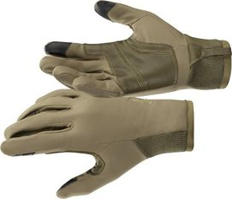 High-tech fabric intended for gloves and other military clothing contains silver mesh that could be heated to keep soldiers warm, while a hydrogel layer would absorb sweat. (Credit: U.S. Army Natick Soldier Research Development and Engineering Center)the gear. The research team is developing textiles for gloves with embedded silver nanowires that generate heat when electrically charged.
Application of only 3 V – the output of a typical watch battery -- to 1-inch by 1-inch test swatches of nanowire-laced polyester and a cotton/nylon blend raises the temperature by 100 F in just one minute. Uniforms made with these experimental fabrics would enable soldiers to dial up or down the voltage to vary the amount of heat produced to match weather conditions. By supplying their own heat, uniforms could be thinner and lighter, an advantage for soldiers who must carry heavy loads and walk long distances.
A layer of sweat-absorbing hydrogel particles made of polyethylene glycol or poly(N-isopropylacrylamide) is also being incorporated into the fabric. The particles are expected to prevent other layers in the fabrics from getting wet, which would keep soldiers more comfortable during missions. The soldiers could release the sweat from uniforms by hanging them up to dry in the warmer indoor air after they return to base.
The researchers say the silver nanowires can withstand repeated laundering, and efforts are now underway to apply the hydrogel so it’s equally durable. Different power sources for the silver mesh are also being evaluated, because batteries would add too much weight to uniforms.
After the fabric for gloves is optimized, the technology might be extended to clothing for the chest and legs, as well as to consumer products.
The research will be presented at the 254th American Chemical Society National Meeting & Exposition, August 20-24, 2017, in Washington, DC.