
A Cure for Bacterial Infections in Hospitals: Copper Nanoparticles
S. Himmelstein | February 19, 2018Bacterial infection is a major issue in hospitals across the U.K. and is increasing due to its spread on surfaces and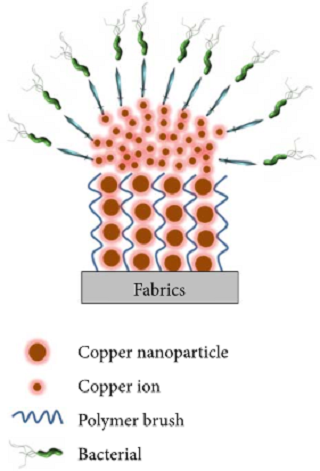 Schematic diagram of copper ions release and antibacterial performance. Source: University of Manchester clothing. A preventative devised by materials scientists at the University of Manchester may soon bring this onslaught of infectious agents to a halt.
Copper, gold and silver have antimicrobial properties and are attracting interest for inclusion in textiles. The researchers focused on copper as the lowest-cost metal of the trio and developed a process for binding copper nanoparticles to cotton and polyester using a polymer brush. The strong chemical bond formed by the Polymer Surface Grafting technique results in excellent washable properties and durability and could pave the way for commercialization of copper-covered uniforms and textiles.
The researchers tested their copper nanoparticles on cotton as it is used more widely than any other natural fiber and polyester as a typical polymeric, manmade material. Each material was brushed with copper nanoparticles in the 1-100 nanometer size range. The coated fabrics displayed significant antibacterial resistance against Staphylococcus aureus (S. aureus) and Escherichia coli (E. coli), even after being washed 30 times. When compared with the traditional process of copper coating, the polymer brush technique proved far more effective.
The research is published in the Journal of Nanomaterials.


The article pointed out: "Copper, gold and silver have antimicrobial properties and are attracting interest for inclusion in textiles."
I found the above mentioned statement quite intriguing, because probably 20+ or more years ago there was one of these 'pyramid' organisations selling alternative medicines, and one of the products, was colloidal silver, which was taken orally, and it cured golden staph infections.
A couple of months ago a friend of mine developed a staph infection after a foot operation. I bought her a bottle of colloidal silver and her doctor told her not to take it........colloidal silver is available in all health food shops (in Australia it is)
Anyhow things did not get better under the doctors treatment - antibiotics - and I finally convinced her to take it, after ringing a naturopath and getting her to convince my friend that she had everything to gain and nothing to lose, by taking the colloidal silver.
The upshot of it all was that in about two weeks her foot started to heal, after the staph infection was hit on the head. She is now back to normal.
In reply to #1
If I'm recalling correctly, the downside of colloidal silver came from overuse, which turned skin gray. Interesting that the silver knocked the staph infection out; I assume that it was one of the resistant strains or the antibiotics would have done the trick. Glad your friend recovered.
In reply to #2
"........ turned skin gray."
A case of the "Walking Dead"