New Portable Field Sensor Accurately Measures Harmful Minerals in Soil
Peter Brown | August 02, 2017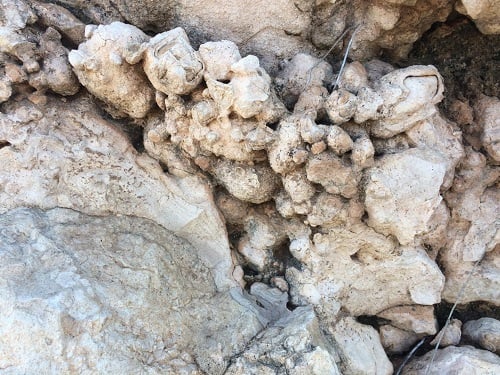 Calcium carbonate accumulation engulfs this soil layer making it difficult for plant roots to break through. Source: American Society of Agronomy When planting crops that go deep into the soil, producers need answers to help the soil on site.
A new portable field sensor has been developed to accurately measure minerals in soils more easily and efficiently than existing methods.
Calcium is necessary for plant growth, but too much calcium can cause soil issues. Calcium carbonate is a type of salt that dissolves in water after a rainfall and moves into the soil. Limestone, a main source of calcium, makes thin threads or small white masses in the soil at low levels. But in extreme cases it can take over the entire subsoil, creating a hard surface that limits the ability of plant roots to grow.
According to findings in the American Society of Agronomy, laboratory techniques are very accurate but are not portable.
So scientists looked to see if a portable X-ray device, called a portable X-ray fluorescence (PXRF) spectrometer, could accomplish the same process. They found that the device is ideal for measuring the calcium in the soil and can provide data on about 20 different elements in about 60 seconds.
Scientists say the big advantage is for soil researchers working in the field or for farmers in developing countries that can’t afford expensive lab tests or can’t appraise the soil.
"We are not advocating doing away with traditional assessment. We are simply providing a new data stream to help field soil scientists when evaluating carbonates in the field," says David Weindorf, a scientist in the Department of Plant and Soil Science at Texas Tech University. "Essentially, PXRF is another tool in the tool belt of the modern soil scientist, but it is by no means the only tool."