How to Make a Nanoparticle
Tony Pallone | July 10, 2017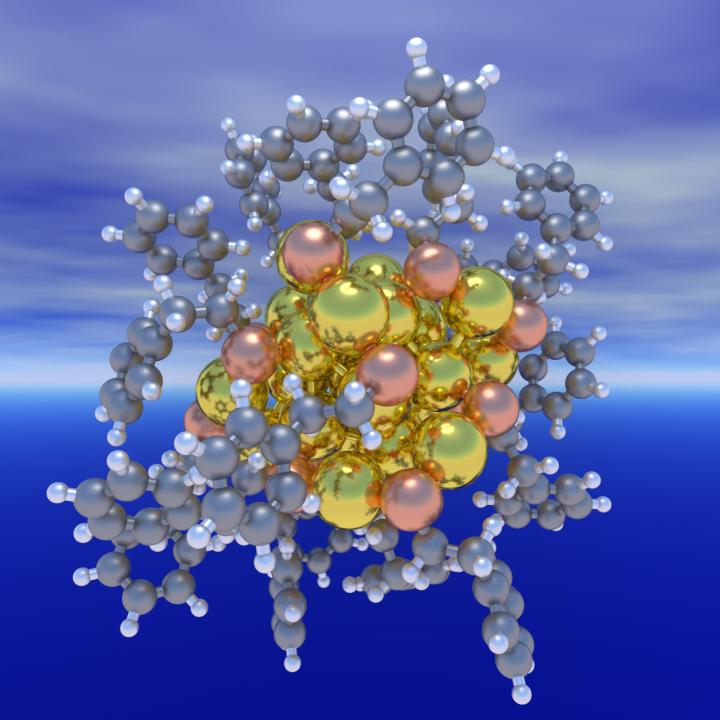 Metal nanocluster. Image credit: Computer-Aided Nano and Energy Lab/C.A.N.E.LA.
How synthesized nanoparticles actually form is an obscure process, which is why trial and error plays a big role in the lab. But a new explanation of the formation of metal nanoparticles, published in Nature Communications by chemical engineers at the University of Pittsburgh's Swanson School of Engineering, sheds some light on at least one area of the nanoscale spectrum.
"Even though there is extensive research into metal nanoparticle synthesis, there really isn't a rational explanation why a nanoparticle is formed," said Dr. Giannis Mpourmpakis, assistant professor of chemical and petroleum engineering and co-author of the study. The research was completed in Mpourmpakis' Computer-Aided Nano and Energy Lab (C.A.N.E.LA.).
"We wanted to investigate not just the catalytic applications of nanoparticles, but to make a step further and understand nanoparticle stability and formation. This new thermodynamic stability theory explains why ligand-protected metal nanoclusters are stabilized at specific sizes."
An understanding of how ligands—molecules that bind to metal atoms—form stabilized metal nanocluster cores is essential to any nanoparticle application process. Mpourmpakis explained that previous theories were based on empirical electron counting rules, but there have been experimentally-synthesized nanoclusters that do not necessarily follow these rules.
"The novelty of our contribution is that we revealed that for experimentally synthesizable nanoclusters there has to be a fine balance between the average bond strength of the nanocluster's metal core, and the binding strength of the ligands to the metal core," he said. "We could then relate this to the structural and compositional characteristic of the nanoclusters, like size, number of metal atoms, and number of ligands.
"Now that we have a more complete understanding of this stability, we can better tailor the nanoparticle morphologies and in turn properties, to applications from biolabeling of individual cells and targeted drug delivery to catalytic reactions, thereby creating more efficient and sustainable production processes."